
Licensing and Activation
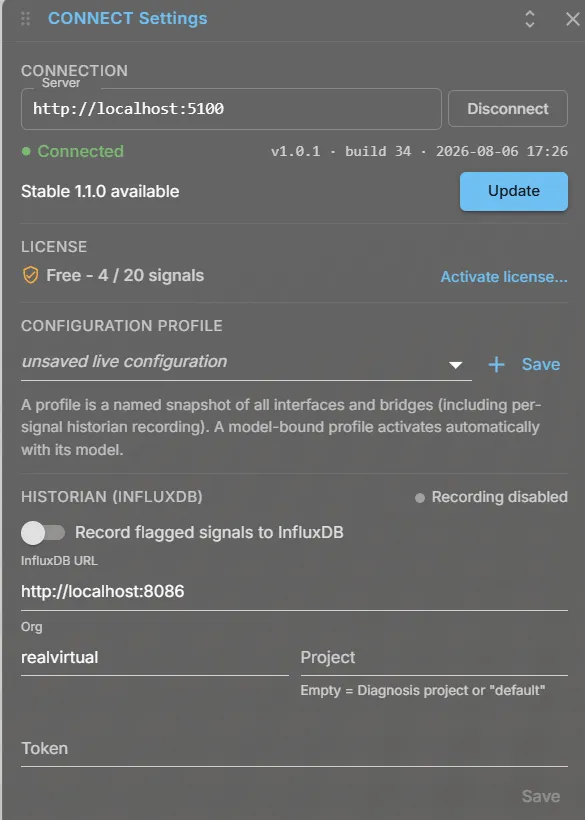
realvirtual CONNECT is free to download and free to use in the Free tier. Activation is a one-time registration with an e-mail address; a commercial license lifts the limits and is bound to the machine it is activated on.
Everything is evaluated locally. The license is a signed token stored on the machine — the gateway does not call home while it runs, and it reports nothing about your signals, models or CAD files. A connection is needed only when you activate or release a license.
| Free | Annual | Lifetime | |
|---|---|---|---|
| Signals | up to 20 | unlimited | unlimited |
| STEP import | up to 25 MB per file | unlimited | unlimited |
| JT import | up to 12 MB per file | unlimited | unlimited |
| Protocols | all supported protocols | all supported protocols | all supported protocols |
| Binding | registration, machine-bound where possible | node-locked, one seat | node-locked, one seat |
| Validity | while registered | one year, renewable | permanent |
Prices for the Annual and Lifetime licenses are published on the realvirtual CONNECT product page.
The signal limit counts admitted signals across all interfaces. Signals beyond the limit are listed by name in the license status, so it is obvious which ones are not being served rather than the gateway silently dropping data.
Free registration
Section titled “Free registration”- Start the gateway and open the HMI.
- Enter your e-mail address when CONNECT asks for it.
- Confirm the magic link in the e-mail you receive. There is no password to choose and none to lose.
- The tray menu shows the active license and the gateway serves signals.
The registration uses the realvirtual community account — the same account that unlocks features in realvirtual. It is bound to the machine when a hardware fingerprint can be read; if it cannot — a virtualised or restricted environment, for example — the registration continues without binding rather than failing.
Commercial activation
Section titled “Commercial activation”A commercial license is issued through the realvirtual customer portal and activated in the gateway’s license dialog. Two ways in:
- Online — the gateway sends its fingerprint to the portal and receives the token.
- Offline — the dialog produces a request code, you exchange it in the portal for an activation key, and enter that key. Nothing has to reach the internet from the machine itself, which is what an air-gapped OT network needs.
Once activated, the token is checked locally. There is no heartbeat and no phone-home.
Moving a seat to another machine
Section titled “Moving a seat to another machine”A commercial license is one seat, bound to one machine — but not stuck there. Release the seat in the license dialog, then activate it on the other machine. The release works online or offline, the same two ways as activation.
Do this before you decommission or re-image a PC. A seat that was never released stays bound to a machine that no longer exists, and freeing it then means a support request rather than two clicks.
Expiry and the degraded state
Section titled “Expiry and the degraded state”An annual license that has passed its end date does not stop the gateway. It enters a degraded state: the gateway keeps running with the free limits until the license is renewed. A machine in service therefore never goes dark because a renewal was late — it loses headroom, not the connection.
Included with a realvirtual license
Section titled “Included with a realvirtual license”The seat above is the engineering license — for building, commissioning and simulation work. For productive operation, CONNECT can already be covered by your realvirtual license:
- A licensed site includes the CONNECT runtime, with all protocols and no signal limit. The site license carries it; no separate CONNECT seat is needed for the machines at that site.
- A machine delivered with a live 3D HMI is covered by one combined, perpetual fee for viewer and gateway together, rather than by two separate licenses.
- Without a live PLC connection — a pure viewer, a sales demo, a planning study — no CONNECT license is needed at all.
The engineering seat stays separate and is not part of that bundle. Terms and prices: realvirtual product page and licensing the viewer.
CAD import limits
Section titled “CAD import limits”The CAD limits apply per file, not per session, so importing several files in one go is fine as long as each one is under the limit. Oversize uploads are refused with a clear reason that names either the license limit or this gateway’s configured capacity.
A gateway’s own configuration can make the limit stricter but never more permissive. Details: CAD conversion.
See also
Section titled “See also”- Installation — download and first start
- Licensing the viewer — what the AGPL viewer requires and when it needs a commercial license
- CAD conversion — where the CAD limits apply