
What You Get
realvirtual is open source. The viewer and its simulation runtime are licensed under AGPL-3.0, and that core is a complete product on its own: you can open a delivered twin, operate it, connect it to live signals and plan a layout with it, without buying anything.
What is commercial are the authoring tools — the workspace where a machine is built from raw CAD in the first place — and a few specialised calculation kernels. Those are the parts that create a twin rather than use one.
You do not have to take that on trust or install anything to find out: the public demo runs the full commercial feature set in your browser, free of charge and without a licence.
Included in the open-source core
Section titled “Included in the open-source core”Every delivery of realvirtual — free or licensed — contains these capabilities:
| Capability | What it does |
|---|---|
| Drives | Linear and rotational motion of machine components. |
| Sensors | Detect parts passing or resting at a position. |
| Transport surfaces | Conveyors that carry material through the model. |
| Sources and sinks | Create and consume moving units, so material flow has a beginning and an end. |
| Grippers and pick-and-place | Pick a part up, carry it and set it down again. |
| Signals and PLC connectivity | Live values from a controller, exchanged over the rv WebSocket Realtime v2 protocol. |
| HMI panels and overlays | Operator panels, status displays and KPI overlays on top of the 3D scene. |
| Camera presets and views | Saved viewpoints so operators reach the relevant part of the machine in one click. |
| PDF document linking | Manuals, drawings and maintenance instructions attached to individual components. |
| Layout planner | Assemble and arrange a layout from reusable parts directly in the browser. |
The Layout Planner is part of the open-source core, not a commercial extension. It ships with every delivery.
Commercial extensions
Section titled “Commercial extensions”These features require a commercial licence in your own deployment:
| Feature | What it adds |
|---|---|
| Asset & Kinematics Editor | The authoring workspace: rename and group parts, assign materials, create kinematic axes and drives, author mechanisms, and save the result back into the model file. Without it you can open and run such a machine, but not build one. |
| CAD Import | Bring in STEP, JT, USD, FBX and Onshape geometry and turn it into a usable model. |
| Robot IK Solver | Interactive inverse kinematics, so a robot follows a target position instead of being moved axis by axis. |
| Kinematic Mechanisms | Closed-loop mechanisms such as cranks, couplers and parallel kinematics. |
| Machining Simulation | Material removal — the workpiece changes shape as the tool cuts. |
| DES Simulation Kernel | The event-driven engine behind material-flow and throughput studies. |
| Physics & Smooth Motion | Physics-based behaviour and smoothed, interpolated movement. |
Trying the commercial features
Section titled “Trying the commercial features”The public demo at web.realvirtual.io/demo runs the full commercial feature set — no licence, no account, no installation. Open the Asset & Kinematics Editor, import your own CAD files, run a DES material-flow study, and try the IK solver, machining and physics, all in the browser.
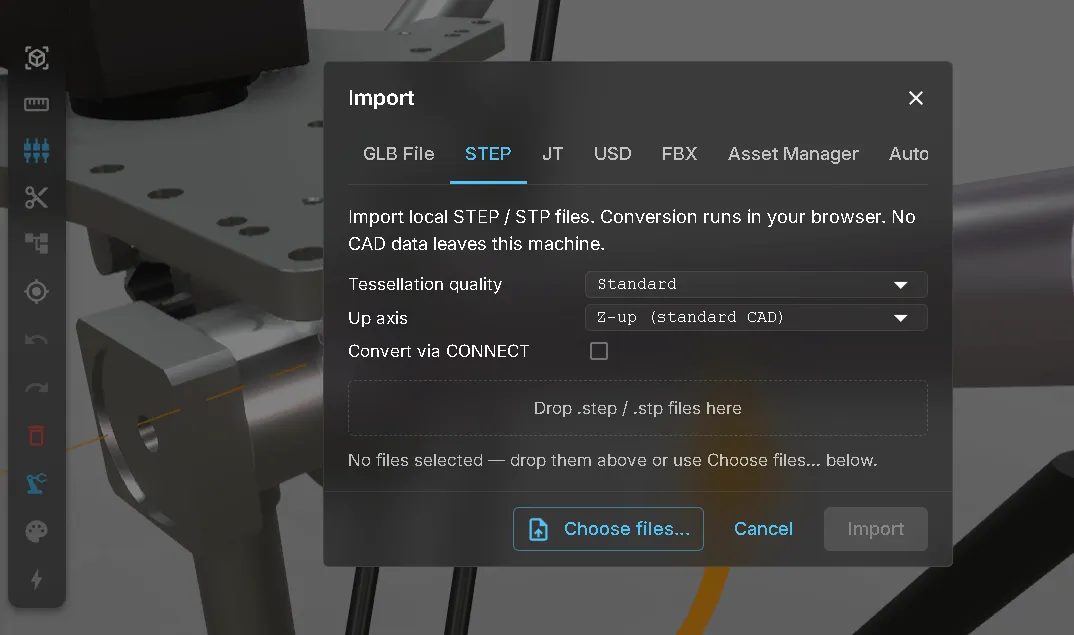
CAD import is worth calling out: the conversion runs locally in your browser. Your geometry is never uploaded, so you can evaluate the importer with real parts from a real project.
The demo is the honest way to decide whether a licence is worth it — you see the actual features on your own data before you talk to anybody.
Free-tier limits
Section titled “Free-tier limits”Two limits apply while you work without a licence:
| Limit | Free tier |
|---|---|
| CAD import file size | 25 MB per STEP file, 12 MB per JT file (JT is licensed separately from STEP) |
| Live signals | 20 signals through the free realvirtual CONNECT tier |
The import limit applies to each file on its own, never to their total: three 10 MB parts imported together are all well within it. Only a single file larger than its limit is refused.
A commercial licence lifts both limits.
See also
Section titled “See also”- Licensing the viewer — what AGPL requires of your own delivery, and when a commercial licence becomes necessary
- Opening a twin — start with a link, a local file or the demo
- CONNECT licensing — the gateway tiers behind the live-signal limit