
Importing CAD
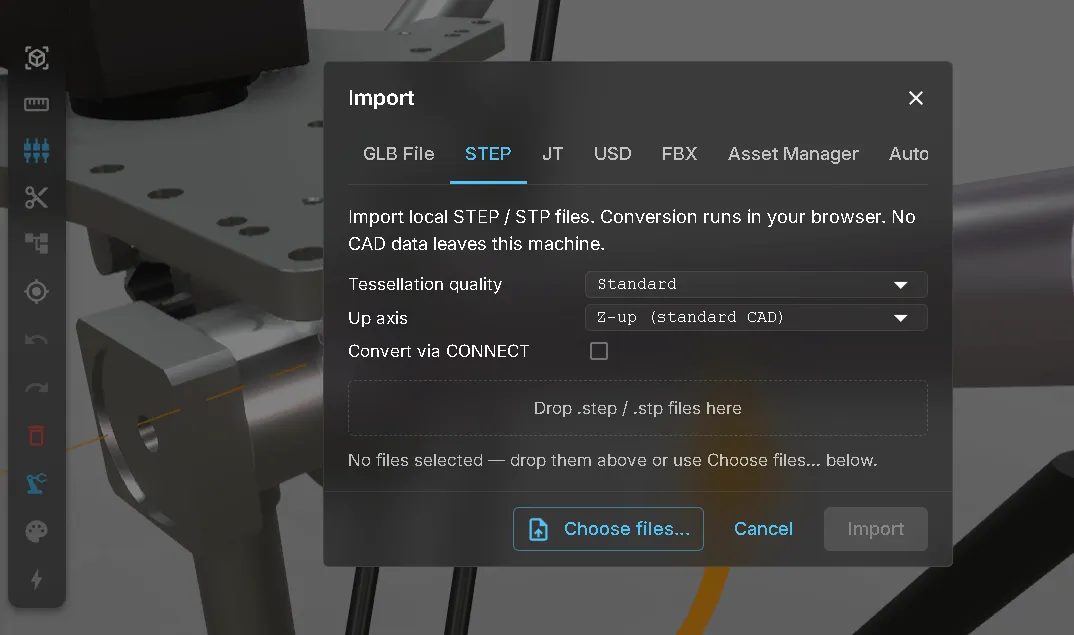
Every import source sits behind one dialog, as a strip of tabs. You pick the tab that matches what you have, set the few options that source needs, and drop the file. There is no separate importer per format and no second place to look.
Local files are read in the browser — nothing is uploaded. When an assembly is too large for a browser tab, the conversion is handed to realvirtual CONNECT running on the same machine, which is still local: the file does not leave the machine either way.
The dialog opens from the Import button in the left toolbar, or directly from a link: ?doc=new&mode=editor creates a new asset, enters the Editor and shows the dialog without a click — see opening a link in a mode.
The seven sources
Section titled “The seven sources”| Tab | What it takes | Notes |
|---|---|---|
| GLB | .glb files | The native format. No conversion, no settings beyond placement. |
| STEP | .step, .stp | Tessellated on import — see the settings below. |
| JT | .jt | Choose a level of detail; a .plmxml picked alongside the geometry brings the assembly’s kinematics with it. |
| USD | USD / USDZ | Already a mesh format, so there is nothing to tessellate. |
| FBX | .fbx | Mesh format as well; units, up axis and the material conversion are handled for you. |
| Asset Manager | Assets from a connected Unity Asset Manager | Browse the connection and pick assets instead of files. |
| Onshape | Geometry from an Onshape document | Requires a one-time sign-in; until then the tab shows a login hint rather than failing an import. |
Whatever the source, the result is the same: GLB bytes, cached under the content hash of the original file. That is why re-opening a document with imported CAD is a fast byte read rather than a second tessellation run.
STEP settings
Section titled “STEP settings”Two settings decide how a STEP assembly arrives:
- Tessellation quality — from Minimal (blocky) through Ultra Low, Very Low, Coarse, Standard (the default) to Fine (detailed). Coarser is faster and lighter; finer keeps small radii round. Quality is recorded with the import, so a later re-import can reuse it.
- Up axis — Z-up (standard CAD) by default, or Y-up. Flip it if the model imports lying on its side.
Convert via CONNECT appears only when a reachable gateway advertises the capability. It converts natively and 64-bit, so the browser’s memory ceiling does not apply.
Auto-align to floor is on by default. Turn it off for multi-part assemblies that must keep their original positions relative to each other.
Cancelling an import
Section titled “Cancelling an import”Cancel ends a running import immediately: the dialog returns to its selection state and, for a conversion running on CONNECT, the server-side job and its converter process are stopped as well. Esc does the same. Clicking the backdrop does not — a stray click must not abort a long conversion.
Moving parts after an import
Section titled “Moving parts after an import”Imported CAD is placed as a reference to the converted asset rather than copied into the document, which keeps the document small and lets the same assembly appear more than once. Moving an inner part of such a reference used to be unsavable; it is now stored as a transform override on the reference node, so the usual sequence — import, nudge a part into place, save, reload — comes back exactly as you left it.
One case is still refused, deliberately: a part inside a reference that is itself inside another reference. Open the referenced asset and move the part there instead.
Re-importing a newer CAD revision
Section titled “Re-importing a newer CAD revision”A node that came from CAD carries a CADLink, and its inspector offers Re-import CAD…. Pick the newer revision of the same file and the subtree is replaced while the work you did on it is carried over: kinematics, drives, sensors, signals and every other component you attached.
Parts are matched by their position in the CAD structure — by the persistent JT handle where one exists, so a renamed part still matches, and by the CAD name path otherwise. Duplicate sibling names are disambiguated by occurrence.
Afterwards you get a preservation report:
- how many component-bearing parts were matched and carried over,
- which ones had no counterpart in the new revision, with the components that were attached to them,
- which parts in the new revision are new.
Nothing is dropped silently, and the whole swap is a single undo step — one Undo restores the previous subtree completely.
Limits without a commercial licence
Section titled “Limits without a commercial licence”In the public demo and on the free CONNECT tier, CAD import is limited to 25 MB per STEP file and 12 MB per JT file. A commercial licence lifts both.
The limit applies per file, so an assembly delivered as several smaller files imports fine. Details: licensing and activation and what the licences require.
See also
Section titled “See also”- Editor overview — what the workspace does with the geometry once it is in
- CAD conversion in CONNECT — converting assemblies too large for a browser tab
- Materials — cleaning up the materials a CAD import brings with it
- Mesh and structure — splitting, merging and grouping the imported tree