
Installation
realvirtual CONNECT is a single Windows executable. There is no installer, no service to register and no admin rights are required for a normal installation. Starting it places an icon in the system tray and opens one listener on port 5100 that serves the REST API, the WebSocket signal channel and the bundled realvirtual HMI.
Requirements
Section titled “Requirements”| Operating system | Windows 10 or Windows 11, 64-bit |
| Runtime | None — the published build is self-contained |
| Network | The PC must reach the controller (PLC, robot controller, MQTT broker) |
| Port | 5100, free on the local machine |
Place the gateway on a PC inside the machine network — an IPC, an edge PC or an engineering laptop. The browser that shows the HMI can be the same PC or any other device in the network.
Download and first start
Section titled “Download and first start”- Download the gateway from web.realvirtual.io/download/realvirtual-Connect.exe - or use the Download realvirtual CONNECT button that the CONNECT panel of any realvirtual viewer shows while it has no gateway to talk to. Both deliver the same current build.
- Start it where it is, or put it in a folder you can write to first - either way, keep it somewhere writable: self-update needs a writable program directory. Accepting the Start-menu entry in step 4 takes care of this on its own.
- Windows SmartScreen may ask for a confirmation on first run - the executable is code-signed by realvirtual GmbH, which the dialog shows under More info.
- A window reports that the gateway is running and where its data goes. Close it, or let it add a Start-menu entry first.
- A tray icon appears. Right-click it and choose Open realvirtual WEB, or open
http://localhost:5100in a browser. - Register once to activate the free tier — see licensing.
The first-start window
Section titled “The first-start window”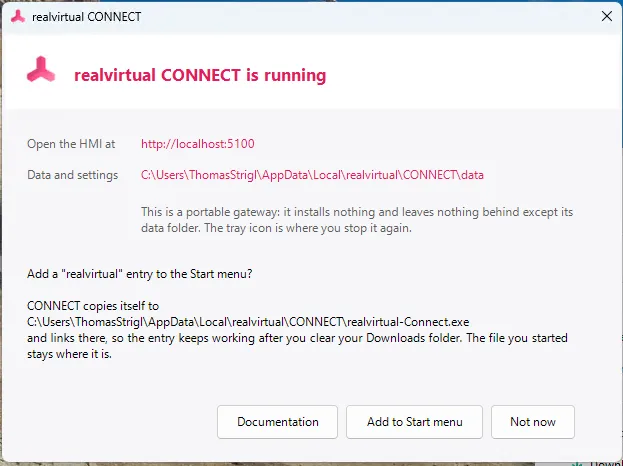
This window appears once, on a new installation, and answers the three questions a first start raises: what is running, how to reach it, and where its data goes.
CONNECT is portable. It installs nothing, registers no service and leaves nothing behind except its data folder. The tray icon is where you stop it again.
The one question it asks is the Start-menu entry. Accepting it copies the executable to %LOCALAPPDATA%\realvirtual\CONNECT\realvirtual-Connect.exe and links there rather than to the file you started — so the entry keeps working after you clear your Downloads folder. The file you started stays where it is; nothing is moved. Not now skips the entry entirely and changes nothing on disk.
The tray menu
Section titled “The tray menu”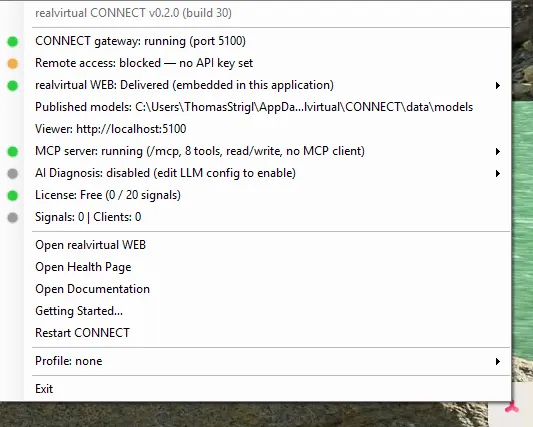
The tray icon is the local status display and the only place with process-level switches. The menu has one reading order: every status line first, then the actions, and the dots say whether anything needs attention — green is running, amber is a state you should look at, grey is off or idle.
The picture shows a fresh installation with nothing configured yet: no model, no interface, no signals, and the free tier. Two lines already ask for a decision — remote access is blocked because no API key is set, and AI diagnosis is off until an LLM is configured.
Status lines
Section titled “Status lines”| Entry | What it shows |
|---|---|
| realvirtual CONNECT v… | Version and build of this executable. Quote it in support requests |
| CONNECT gateway | Port and running state |
| Remote access | Appears only while the gateway is reachable from other machines with no API key configured — those clients are refused. Click it for the full explanation, and see remote access |
| realvirtual WEB | Where the HMI comes from — Delivered (embedded in this application) on a normal installation, or a separately running dev server. Its submenu holds the data folder and, in development, the dev-server controls — see viewer delivery |
| Published models | The folder the gateway serves models from. Click to open it |
| Viewer | The address the HMI is reachable at. Click to open it |
| MCP server | Endpoint state, tool count, write access and connected MCP clients — see AI clients |
| AI Diagnosis | Index state, or the reason it is off — see AI diagnosis |
| License | Current tier and, on the free tier, how many of the allowed signals are in use — see licensing |
| Signals / Clients | How many signals the gateway serves and how many browsers are connected. This Clients count means viewers, not MCP clients |
Actions
Section titled “Actions”| Entry | What it does |
|---|---|
| Open realvirtual WEB | Opens the HMI in the default browser |
| Open Health Page | Opens the gateway’s own status answer — the fastest check when something looks wrong |
| Open Documentation | Opens this documentation in the default browser |
| Getting Started. | Reopens the first-start window, including the Start-menu entry |
| Restart CONNECT | Restarts the gateway process, for example after a startup-only setting was changed. It takes everything in this executable with it; to restart only a dev server, use the realvirtual entry |
| Profile | Switches between saved configuration profiles (saved in the viewer’s CONNECT panel). Switching hot-reloads the interfaces - the gateway is not restarted |
| Exit | Closes the gateway. In development mode the caption names what goes with it: a dev server CONNECT started is stopped too, while one that was already running when CONNECT started keeps running |
Where CONNECT stores things
Section titled “Where CONNECT stores things”| What | Location |
|---|---|
| Interfaces, signals and profiles | %PROGRAMDATA%\realvirtual\CONNECT\connect-config.json |
| Models, viewer settings, converted CAD, history state | %LOCALAPPDATA%\realvirtual\CONNECT\data (models/, settings.json) |
| The activated license | %PROGRAMDATA%\realvirtual\CONNECT — machine-global, it never follows a workspace |
| Process settings — port, API key, allowed origins | appsettings.json next to the executable |
The tray menu shows both folders: Published models opens the model folder, and the data root sits in the submenu of the realvirtual WEB line.
Configuration is written atomically with a .bak backup. Changes take effect immediately: the affected interface restarts on its own, the gateway does not.
Process settings
Section titled “Process settings”appsettings.json holds the settings that are read at startup:
{ "Urls": "http://0.0.0.0:5100", "AllowedOrigins": ["*", "https://web.realvirtual.io"], "ApiKey": "", "Logging": { "LogLevel": { "Default": "Information" } }}| Key | Purpose |
|---|---|
Urls | Listen address. The default binds all network adapters, so the gateway is reachable from other machines — read remote access before leaving it that way |
AllowedOrigins | Browser origins allowed to call the gateway (CORS), and the origins whose viewer pages may attach an AI Bridge. The hosted viewer on web.realvirtual.io is trusted out of the box, so it can pair with this gateway without any edit |
ApiKey | Required from any caller that is not on the local machine. Empty disables the key |
Running two gateways on one PC
Section titled “Running two gateways on one PC”Port 5100 is part of the client contract: .mcp.json, the HMI, the REST API and the signal channel all name it. CONNECT therefore refuses to start on a taken port instead of silently moving to another one. To run a second gateway deliberately, set the environment variable REALVIRTUAL_CONNECT_PORT for that instance and point its clients at the same port — in the viewer with ?mcpPort=<port> in the address, in .mcp.json with the matching URL. The full list of environment variables is in the configuration file reference.
Autostart
Section titled “Autostart”To start the gateway with Windows, place a shortcut to the executable in the startup folder — press Win+R and enter shell:startup. CONNECT starts into the tray and reconnects its configured interfaces automatically.
Uninstalling
Section titled “Uninstalling”Delete the executable. To remove everything else as well, delete %LOCALAPPDATA%\realvirtual\CONNECT\ (data, and the copy of the executable if you accepted the Start-menu entry), %PROGRAMDATA%\realvirtual\CONNECT\ (configuration and license) and the realvirtual group in the Start menu. Nothing is written to the registry, and no service is left behind.
See also
Section titled “See also”- Licensing — Community registration and commercial licenses
- First connection — from a running gateway to live values in the browser
- Troubleshooting — the gateway does not start, the browser stays empty