
Opening a Twin
realvirtual opens an industrial digital twin directly in your browser. A twin can arrive as a shared link, a local GLB file, or an example in the public demo. You do not need to install a viewer or create an account to open the public demo or a prepared delivery link.
The preferred delivery format is GLB with rv_extras metadata. It keeps geometry, hierarchy and realvirtual component information together in one self-describing file.
Browser does not mean cloud
Section titled “Browser does not mean cloud”The most common misunderstanding about realvirtual is that “runs in the browser” implies “runs on somebody’s server”. It does not. The browser is the runtime, not the location — and the same viewer runs in four places, with the same file and the same behaviour:
| Where | What it needs | Typical use |
|---|---|---|
| On your own computer | Nothing but the browser — drag a GLB in, or run realvirtual CONNECT, which serves the viewer on localhost | Engineering, service calls, a machine on an isolated network |
| Static hosting | Any web server or CDN that can serve files — no application server, no database, no runtime | Intranet, customer portal, your own domain |
| Hosted by realvirtual | An account for the hosted features | Trying things out, sharing a document |
| Air-gapped or frozen | A copied folder | Delivery with a machine, ten-year documentation duty |
Two consequences worth stating plainly:
- Rendering and simulation happen on your device. There is no remote render service, no upload of your model, and no round-trip to a server for the animation. A local file never leaves the browser.
- The viewer is open source under AGPL-3.0. You can host it yourself, keep it running after any subscription ends, and inspect what it does — the source is on GitHub. What the open licence asks in return is described under licensing the viewer.
That combination is the point: an interactive machine model that opens like a document, survives ten years in an archive, and needs no service in the middle to keep working.
Ways to open a model
Section titled “Ways to open a model”- Shared link or URL — Open the address supplied with the twin. The link can select a prepared model and workspace.
- Local GLB file — Drag a
.glbfile from your computer onto the viewer to open it locally. - Public demo — Open the realvirtual demo to explore a prepared twin without supplying a file — five ready models, from a robot cell to a complete laser welding line, described under Demo Models. The demo runs the full commercial feature set for evaluation; the free-tier limits apply — CAD import up to 25 MB per STEP file and 12 MB per JT file, and live PLC connectivity through the free realvirtual CONNECT tier serves up to 20 signals.
- Served by the gateway — Start realvirtual CONNECT on the machine PC and open
http://localhost:5100. The viewer comes from the gateway itself, with live signals attached and no internet connection involved.
You always have somewhere to save
Section titled “You always have somewhere to save”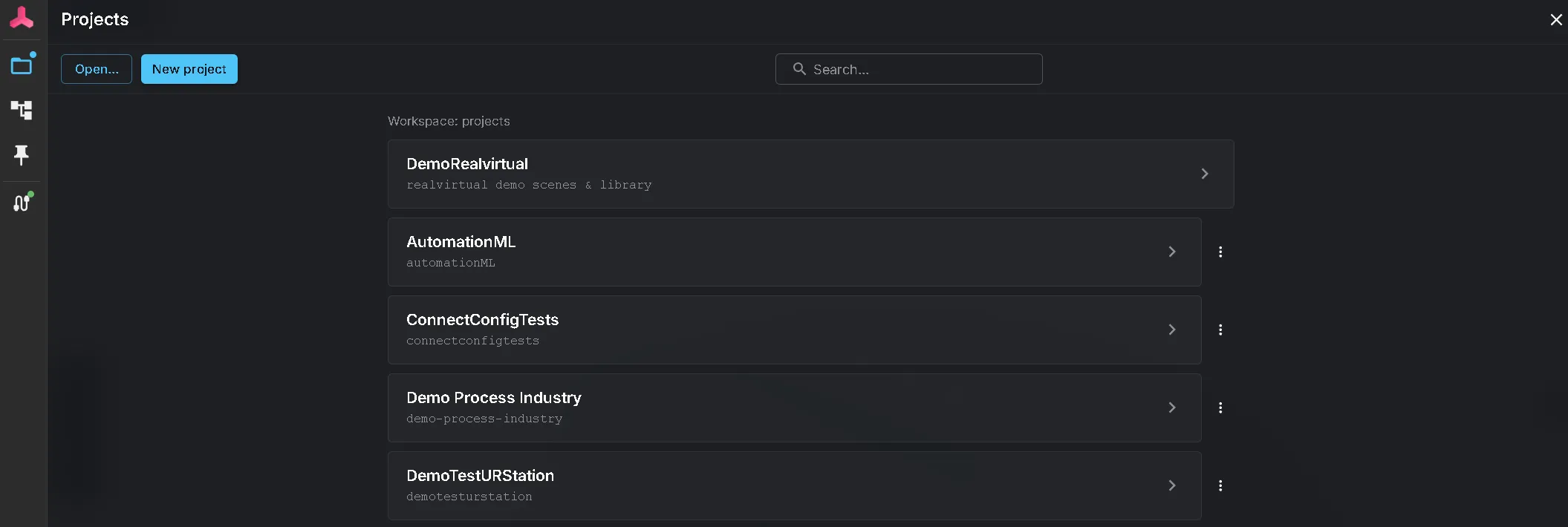
You never have to create a project before you can work. When nothing else applies, realvirtual opens My Workspace — a project that lives in your browser and that every document has as its home. There is no setup step and no empty-state to get past: drag a file in and it has somewhere to go.
Two things follow from that, and both surface as questions rather than as silence:
- Switching to a folder project asks for write access first. A project in a folder on your computer is only writable while the browser has permission for it, and the browser only grants permission in response to a click. So the request arrives at the moment you switch. Declining it does not fail the switch — the project opens read-only, and you can grant access later.
- A project that does not come back tells you why. Permission for a folder can lapse between sessions, and a folder can move or become unreadable. Where the project you last used cannot be restored, the viewer says which of the two happened and opens the project list so one click re-grants access — instead of starting somewhere else and leaving you to work out what changed.
When you reopen a project, it returns to the document you last had open in that project, not to whatever was open last overall.
System requirements and privacy
Section titled “System requirements and privacy”Use a current browser with JavaScript and WebGL enabled. realvirtual supports desktop and tablet use; the available performance depends on the device and the size of the model. Because rendering happens on your device, the graphics card the browser uses decides how the viewer feels — Browser & GPU setup covers how to check that and how to correct it.
Rendering runs on your device rather than on a remote rendering service. A local file stays in the browser while you view it. When you open a hosted link, the browser downloads the twin from the host selected by its provider; a live setup exchanges only the machine data configured for that connection.
Quick Start
Section titled “Quick Start”- Open the URL supplied with your twin, or open the public demo.
- To use your own file, drag the
.glbfile onto the viewer and wait for the model to fit into view. - Confirm that the scene appears, then select a component or open the hierarchy to start exploring.
- If the model does not load, verify that JavaScript and WebGL are enabled and try the file or link again in a current browser.
See also
Section titled “See also”- Demo Models — the five twins in the public demo, each with a one-click link
- The Screen & Workspace Modes — what each area of the screen is for, and how to switch modes
- Your First Twin from CAD — build your own twin from a STEP file
- Build a Twin with AI — let an AI assistant do it through MCP
- Navigation and controls
- Browser & GPU setup
- Documents
- Deployment options