
Machine Information System (3D HMI)
A 3D model that only looks like the machine is a picture. The machine information system is what turns it into something you can ask questions of: which valve is this, what is it doing right now, where is its datasheet, and why did it stop.
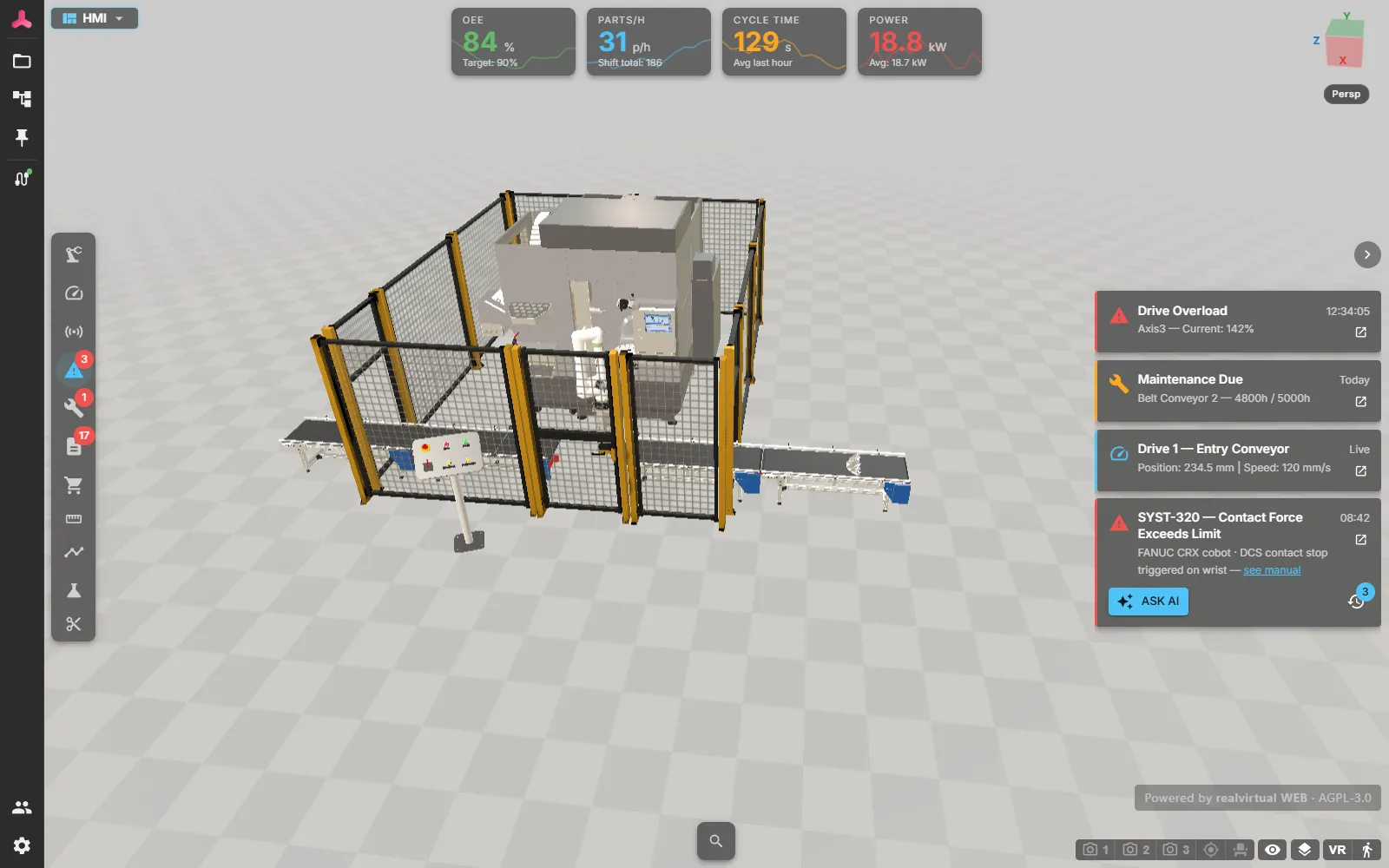
All of it hangs on the model itself. A part carries its own information, so an operator finds it by pointing at the thing in front of them rather than by knowing a document number.
The machine information system is one of the use cases of realvirtual. It starts from a twin built in the Editor or exported from Unity.
What it covers
Section titled “What it covers”| Feature | What it gives you |
|---|---|
| Signals and alarms | Live values from the controller shown on the part they belong to, plus alarms and machine states |
| Part information | Type plates, order numbers, spare part numbers and free-form data on any part |
| Documents and links | Datasheets, drawings and manuals attached to a part and opened from the 3D view |
| Visual markers | Sensors, faults and safety doors made visible in the model, so a state is a thing you see rather than a line in a list |
| Asset Administration Shell | Industry 4.0 asset data from the AASX files in your project, shown next to the part |
| AI diagnosis | Answers grounded in your own machine documentation instead of general knowledge |
Where the information comes from
Section titled “Where the information comes from”Machine information travels inside the GLB. There is no side-car file, no separate database and no configuration to keep in sync: the model carries its own information, so a model that arrives anywhere arrives complete.
That has a practical consequence worth knowing before you start: whoever hands over the model hands over the information with it, and a model exported today keeps working with a viewer released later.
Authored in Unity
Section titled “Authored in Unity”If the twin is built in realvirtual for Unity, the information is authored there and exported with the model. The Unity side has its own components for it — markers for sensors, faults, safety doors and pivots, the AAS link, and the metadata that fills a part’s information panel.
See the Unity documentation: 3D HMI components.
Authored in the browser
Section titled “Authored in the browser”Unity is not a requirement. The Editor works on a GLB directly in the browser: import CAD, give the parts structure and kinematics, and add the same machine information there. That path exists for the case where the model comes from CAD rather than from an existing Unity project, and for changing information later without going back to the authoring tool.
Both routes write the same data into the same file, so a model can start in one and be refined in the other.
Quick Start
Section titled “Quick Start”- Open a twin and click a part in the 3D view.
- The information panel shows what that part carries — values, data and documents.
- Missing something? Add it in Unity or in the Editor and export the model again.
See also
Section titled “See also”- Signals and alarms — the live half of the picture
- Operator Panel — the machine’s control box on the screen
- AI diagnosis — asking the machine what went wrong
- Editor — authoring machine information without Unity
- Documents — how a document gets into the viewer