
Virtual Commissioning
realvirtual includes the functions for virtual commissioning in the browser: a running digital twin that is connected to the real or simulated controller and tested with it before the machine is built. No Unity installation and no separate simulation tool is needed.
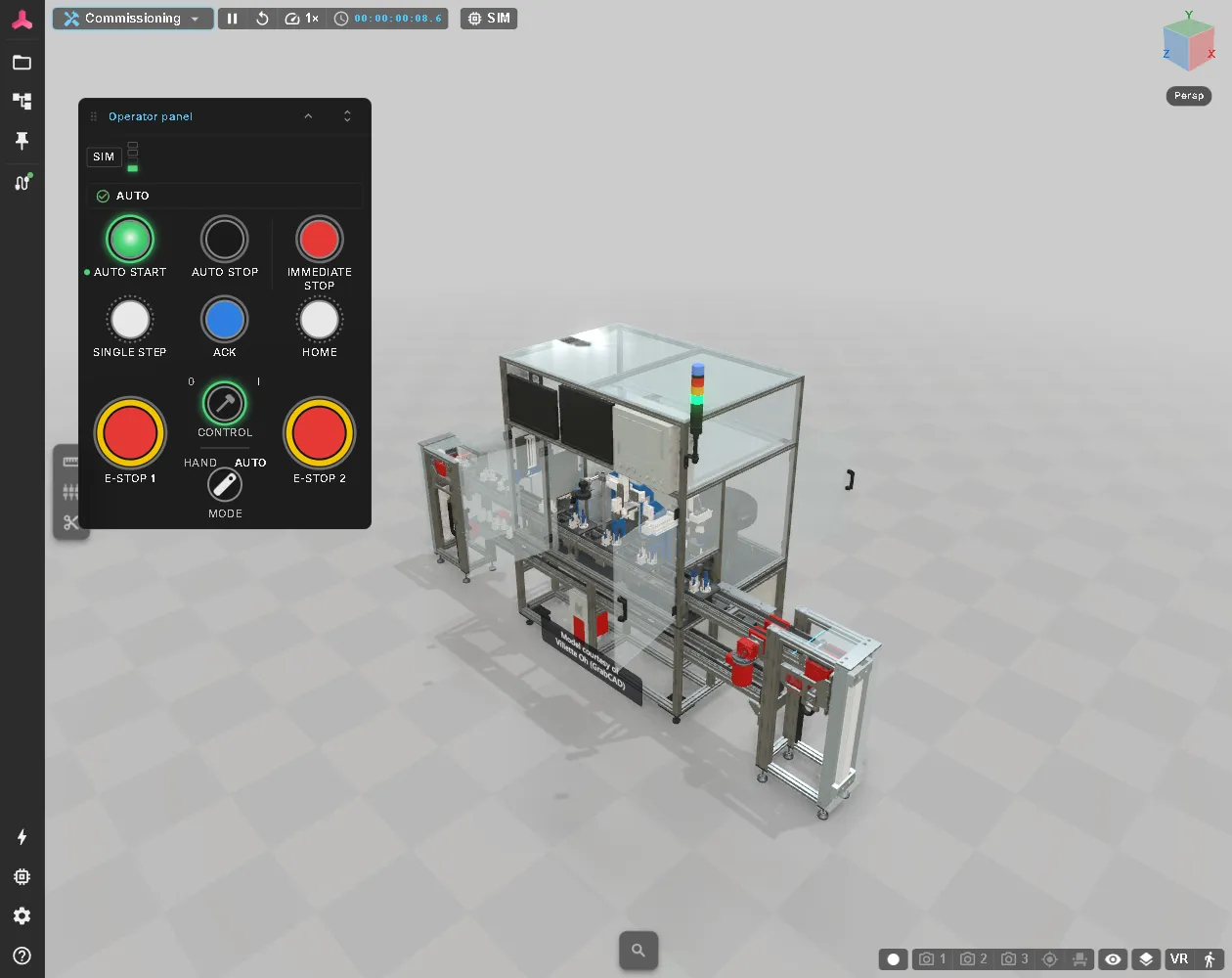
Virtual commissioning is one of the use cases of realvirtual. It starts from a twin built in the Editor or exported from Unity.
Functions
Section titled “Functions”| Function | What it provides | Details |
|---|---|---|
| Commissioning workspace | Inspector, hierarchy, signals, CONNECT and the AI bridge in one workspace; can be opened or shared directly as a link | Screen and Modes, Sharing |
| PLC signals | Inputs and outputs of the twin, named like the PLC tags and bound to drives, sensors and lamps | Signals and Logic, Signal Binding |
| Controller connection | Connects the twin to a PLC, a PLC simulation such as PLCSIM Advanced, or a robot controller — over OPC UA, S7, TwinCAT ADS, Modbus, EtherNet/IP, MQTT and more | Connecting a PLC, Interfaces |
| Signal discovery | Reads signals from a live connection or a symbol table, such as a TIA .sdf export | Interface configuration |
| Simulation / PLC mode | Switches between the model’s own logic and the connected controller; a controller takes over automatically when it writes its first output | Signals & Alarms |
| Operator panel | The machine’s control panel on screen — push buttons, selector switches, E-stops, stack light — wired to the same PLC signals as the real one | Operator Panel |
| Virtual PLC | Logic steps, or a Structured Text program in the browser, that run the twin without a controller | Logic steps, Virtual PLC (ST) |
| Forcing | Holds a signal at a fixed value to test a reaction | Signal Binding |
| Collision detection | Checks moving geometry for collisions while the simulation runs | Collision Detection |
| AI assistant | Reads and writes signals, drives and components of the running twin through the AI bridge | AI bridge |
Example
Section titled “Example”The Laser Welding Assembly Station uses these functions together: 193 PLC signals named like the station’s TIA tag list, a virtual PLC of eleven Structured Text programs, an operator panel and the Simulation / PLC mode.
See also
Section titled “See also”- Connecting a PLC — CONNECT between the twin and a real or simulated PLC
- Machine Information System — signals, alarms and documents in operation
- realvirtual CONNECT — the gateway between twin and controller
- Components — drives, sensors and material flow of the twin