
1. Build the twin
Import CAD in the Editor and add kinematics, drives, signals and snap points.
The browser-based platform for delivering, operating and planning with your digital twin — no installation, no account, open source.
Getting started Try the live demo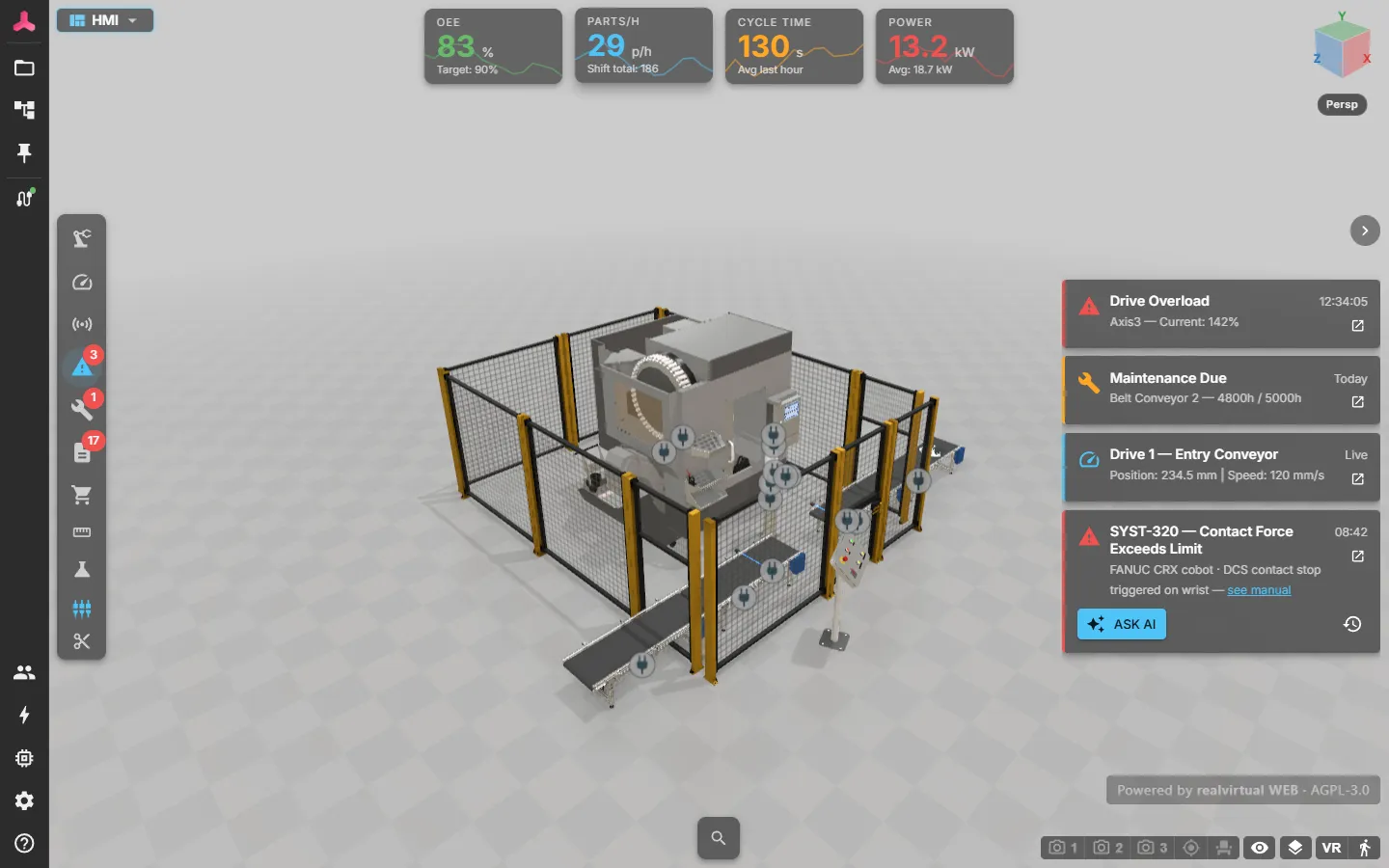
realvirtual brings an industrial digital twin into the browser as a 3D viewer, HMI and machine information surface. A prepared GLB keeps geometry and realvirtual metadata together, so operators, maintenance teams and planners can open the same delivered twin without learning Unity or installing a viewer.
Use it in standalone mode for an interactive model, or connect it to live controller data for machine monitoring. Planning and discrete event simulation are available as beta workspaces for layouts and material-flow studies.
The viewer, its simulation runtime and the Layout Planner are open source under AGPL-3.0, so opening, operating and planning with a delivered twin costs nothing. Commercial licences cover the authoring side — the Asset & Kinematics Editor, CAD import — and a few calculation kernels such as robot IK, machining and discrete event simulation. The public demo runs the full commercial feature set in your browser without a licence, so you can try all of it before deciding. See what you get for the complete split.
These pages document realvirtual, the browser platform. realvirtual for Unity — the Unity-based engineering platform, Starter and Professional — has its own documentation at doc.realvirtual.io.
1. Build the twin
Import CAD in the Editor and add kinematics, drives, signals and snap points.
2. Choose the use case
Layout planning, virtual commissioning, discrete event simulation or the machine information system (3D HMI).
3. Deliver and operate