
Discrete Event Simulation (Beta)
Discrete event simulation (DES) analyzes material flow through a layout directly in the browser. Instead of updating every visual frame, it advances between relevant events, which makes it suitable for faster throughput and utilization studies.
DES mode keeps planning and analysis close together: you can run a prepared material-flow model, accelerate the study, review statistics and organize repeated runs as experiments.
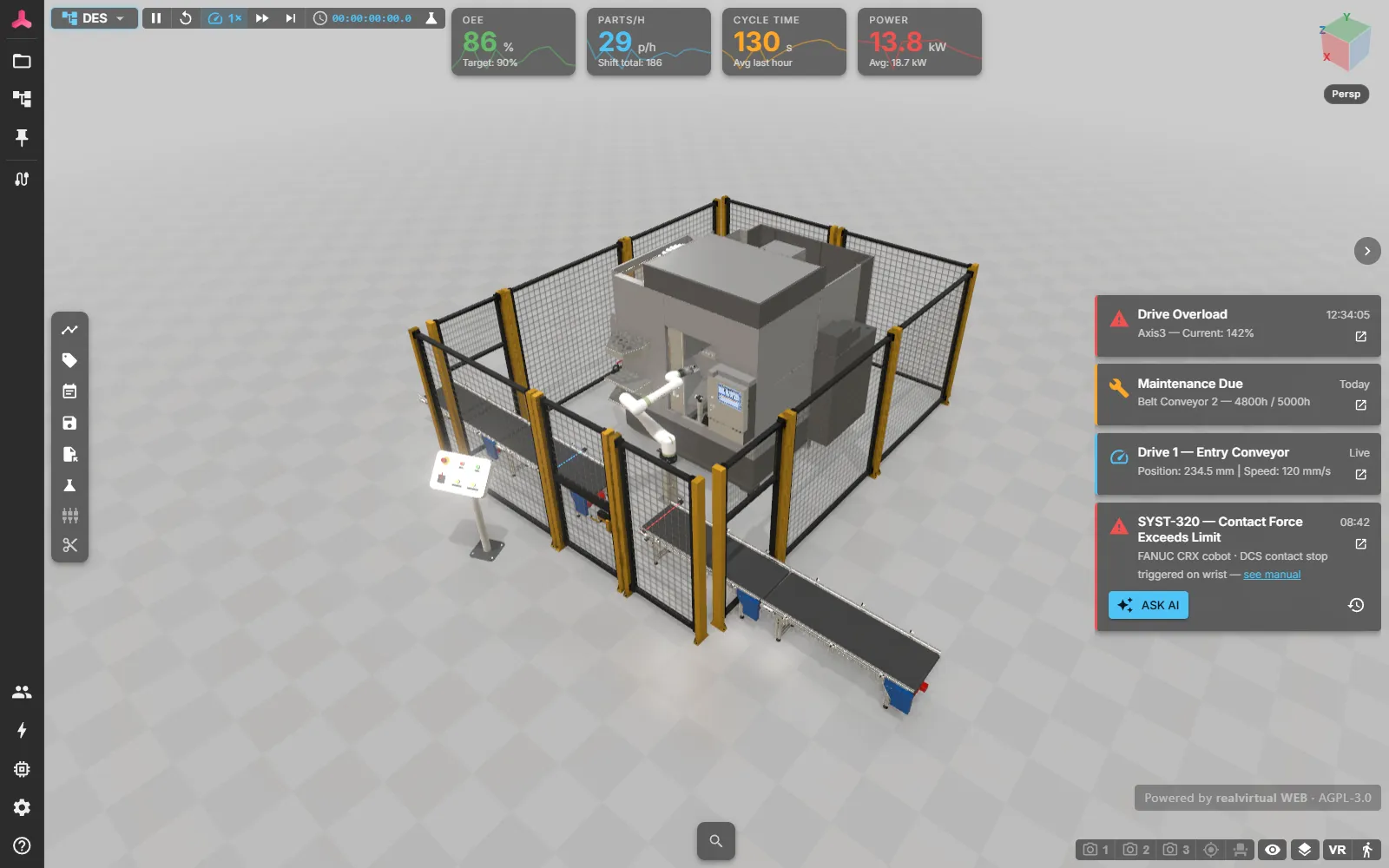
Discrete event simulation is one of the use cases of realvirtual. It starts from a twin built in the Editor or exported from Unity.
Core functions
Section titled “Core functions”- Material-flow statistics summarize throughput and utilization for the simulated layout.
- Fast-forward advances an event-driven run faster than real-time when you do not need to watch every movement.
- Projects and experiments group related scenarios and repeated runs for comparison.
- Runs and checkpoints retain a simulation state so a stored point can be loaded and continued.
- Run comparison combines selected runs from the same project and reports their statistical result.
Where the routes come from
Section titled “Where the routes come from”The paths vehicles travel along are not a separate DES model. They are ordinary objects in the Layout Planner, drawn and edited there with drag handles and snap points, and undone and saved like any other layout change. Changing a route is therefore a planning action, and the run picks up the new geometry without a rebuild.
Material-flow behaviour attaches to a component because the component carries it, not because of where it was placed — so an object authored in the Editor and dropped into a layout takes part in the simulation straight away.
Organising repeated runs
Section titled “Organising repeated runs”Projects, experiments, runs and checkpoints, the seed modes that make a run repeatable, comparison across runs as mean ± 95 % confidence interval, and export of an experiment as a portable file are covered under experiments and runs.
Quick Start
Section titled “Quick Start”- Open a layout that contains a prepared material-flow simulation.
- Switch the workspace to DES.
- Start a run and observe the material-flow statistics rather than relying only on visual motion.
- Use fast-forward when you want to reach a later simulation time more quickly.
- Open the experiments area to identify the active project, experiment and run.
- Repeat the scenario with the intended settings, then select the relevant runs for comparison.
See also
Section titled “See also”- Experiments and runs — organising, comparing and exporting simulation runs
- Layout Planner
- Documents
- Deployment options