INSIGHTS FROM
INDUSTRIAL AUTOMATION

Newsletters, opinion pieces, and insights about realvirtual.io, Virtual Commissioning, and Industry 4.0.

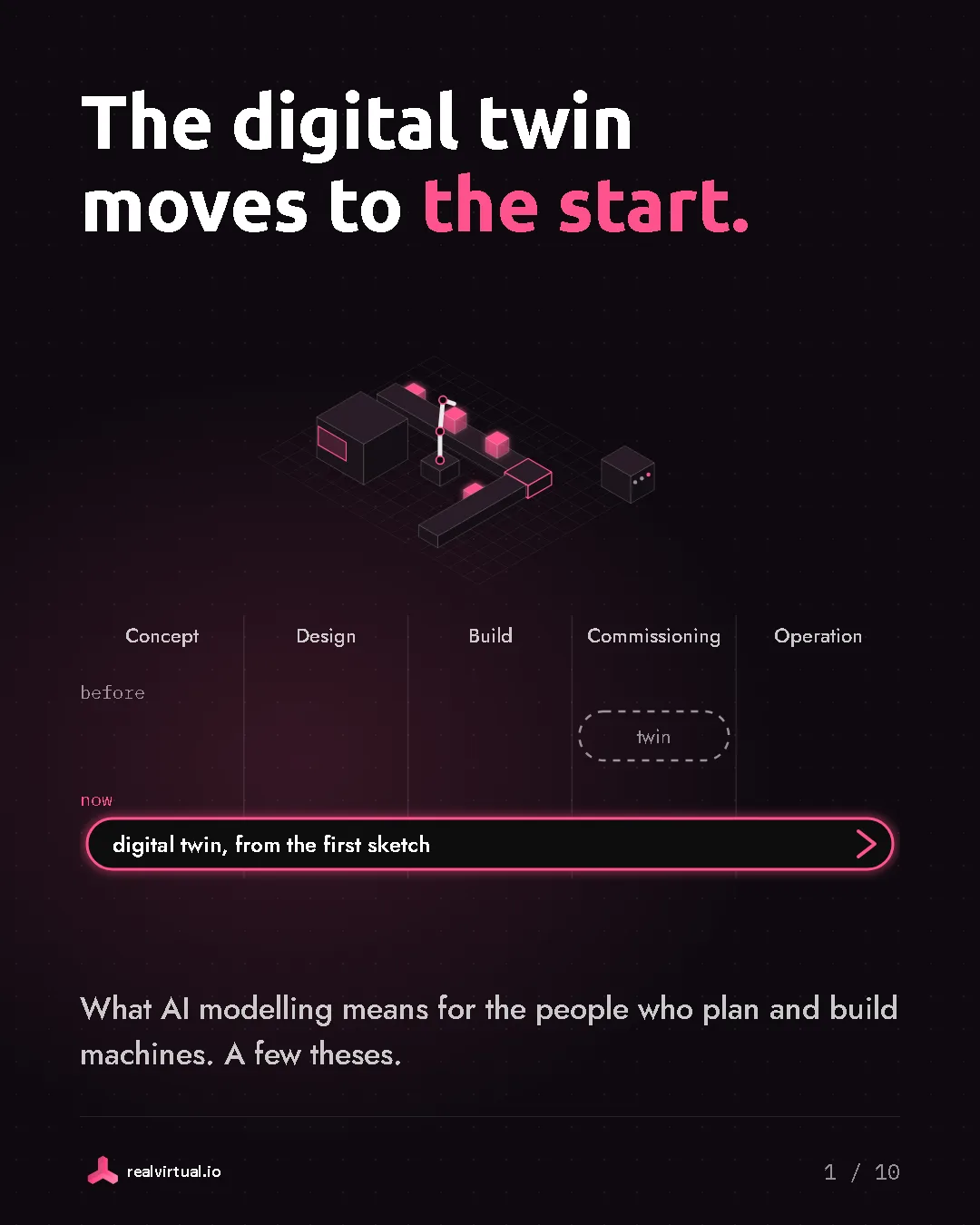
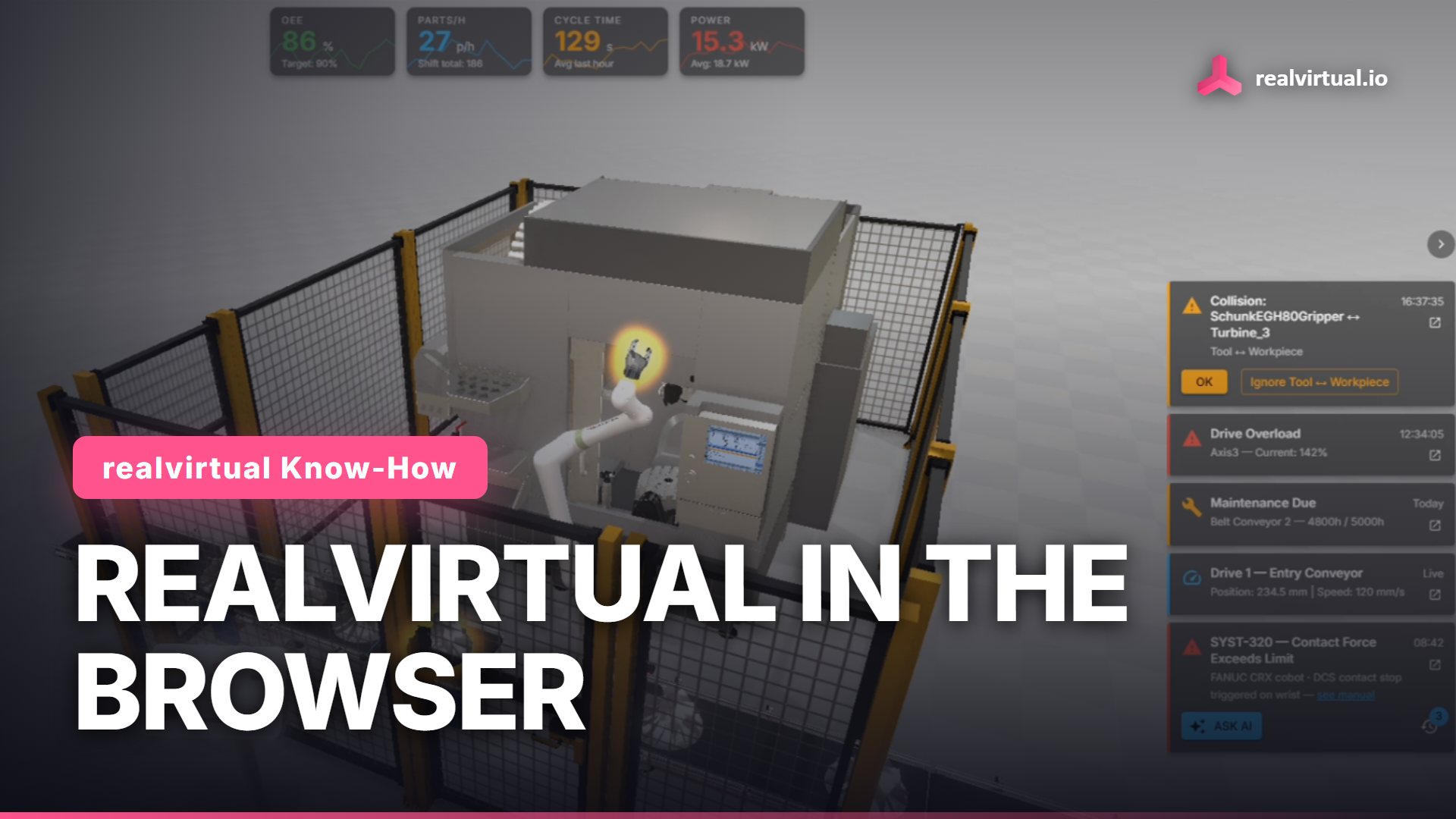
The machine in this clip started as a CAD export nobody had named. Part numbers instead of part names, no structure, nothing that moves.

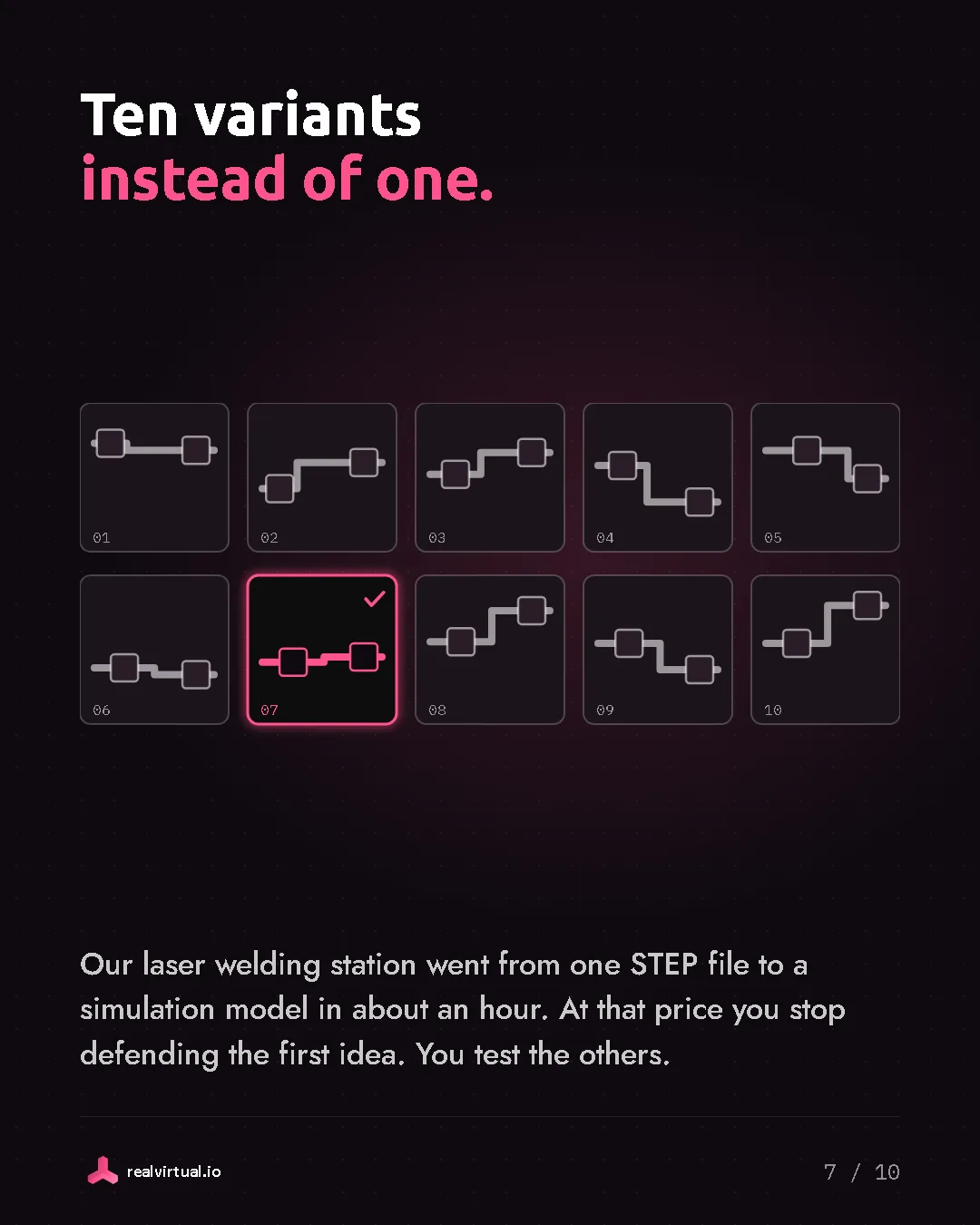
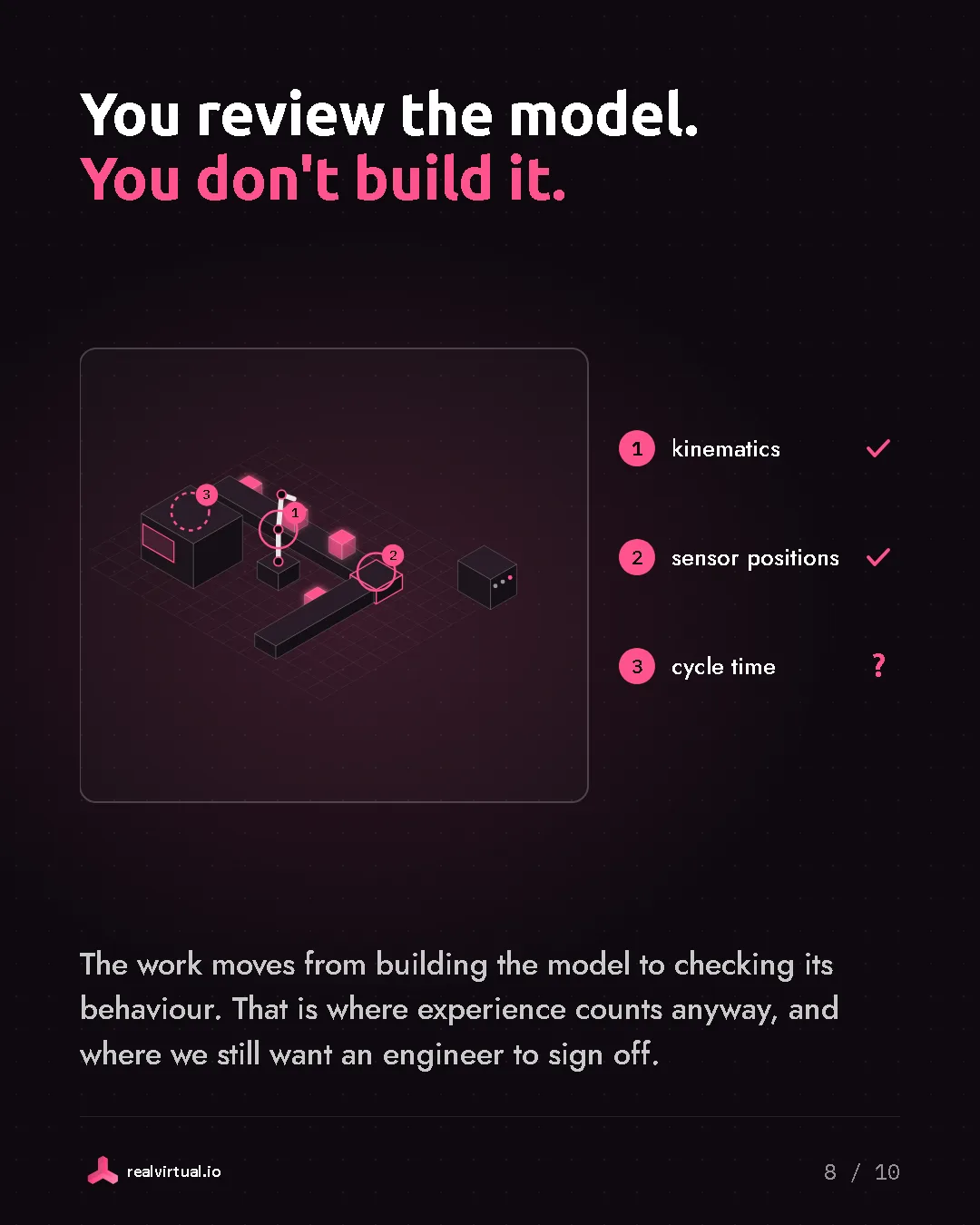
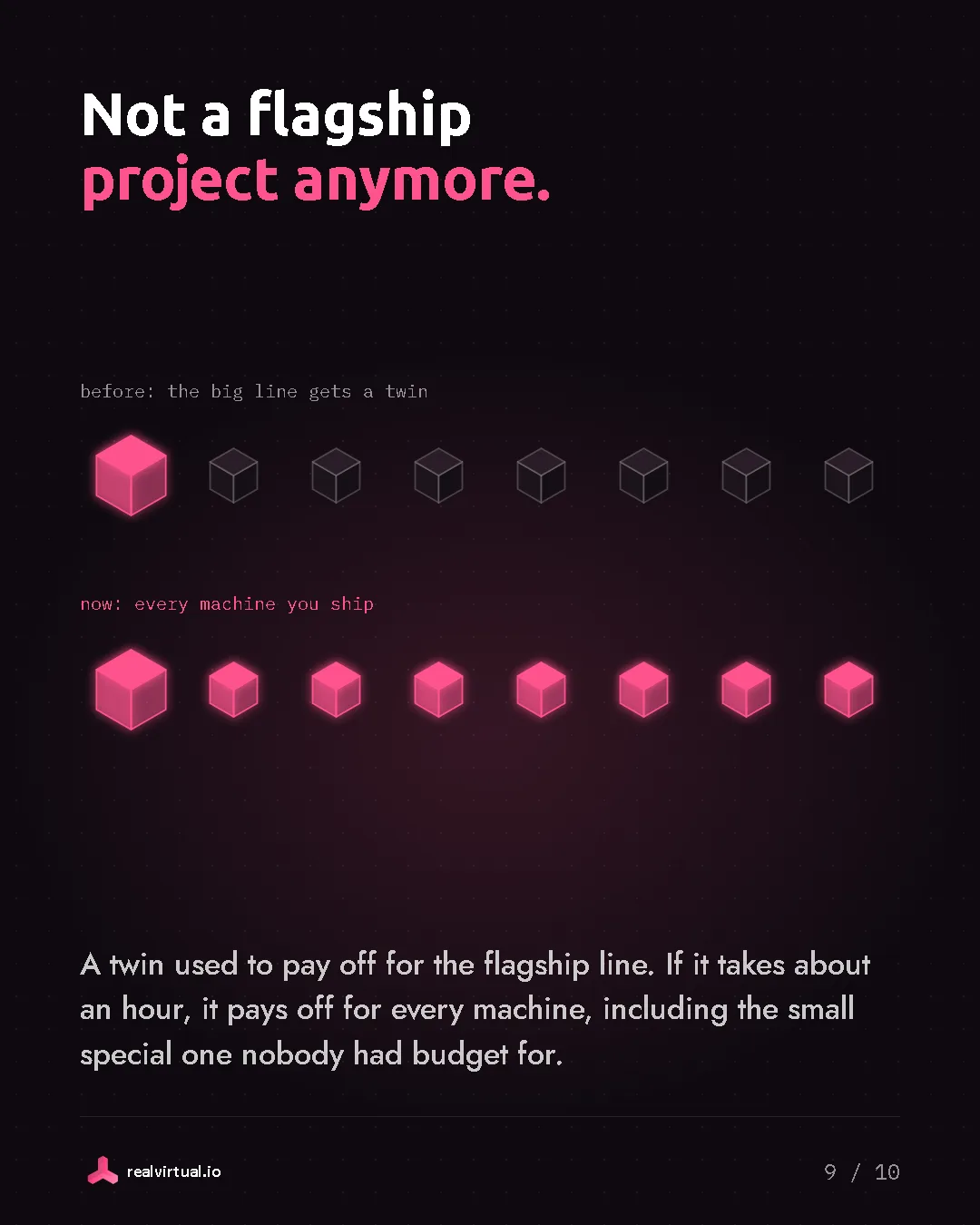
Less than an hour later it has a kinematic structure, drives, logic steps and a demonstration run it plays on its own. With materials that make it look like a machine instead of a grey CAD dump.

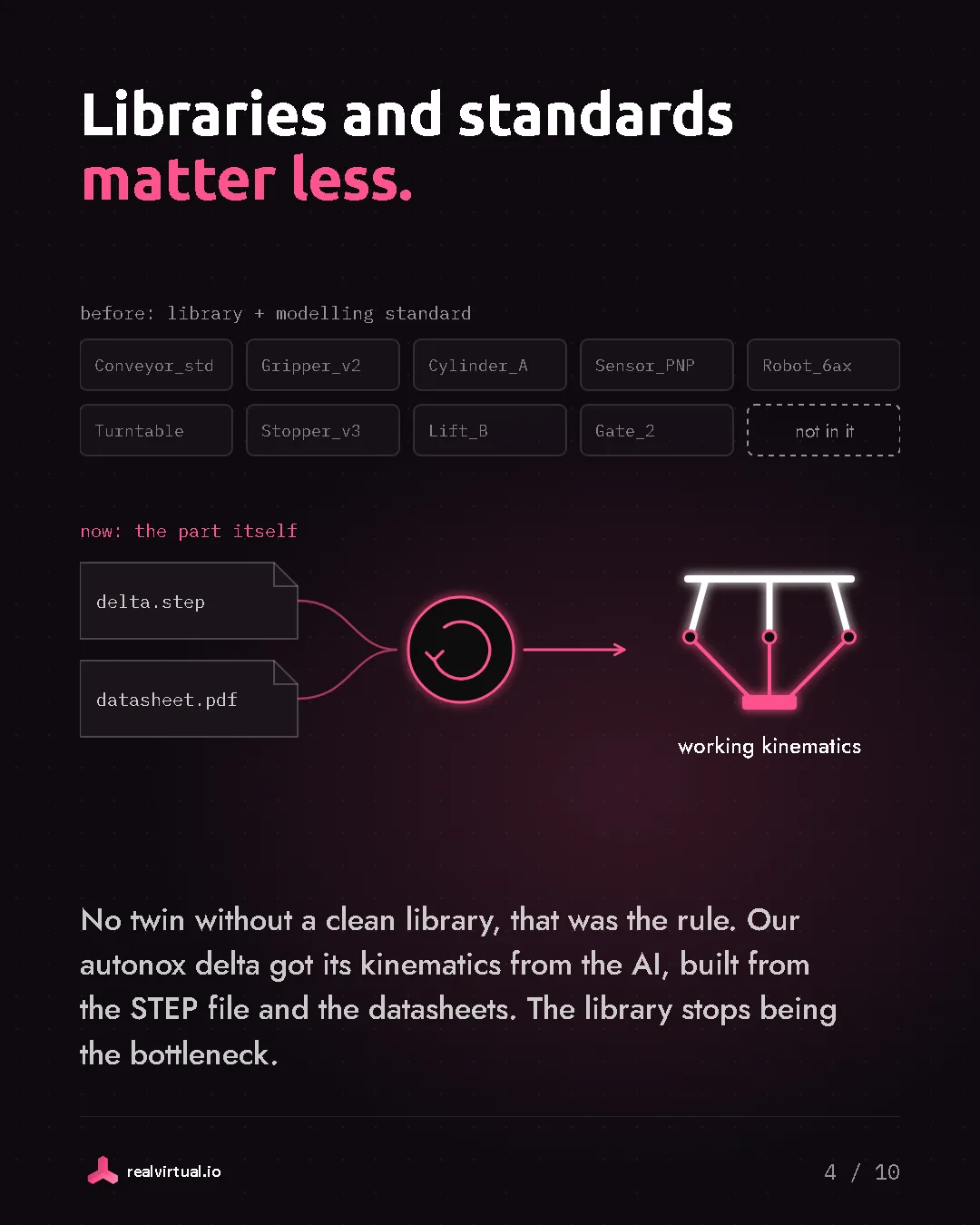
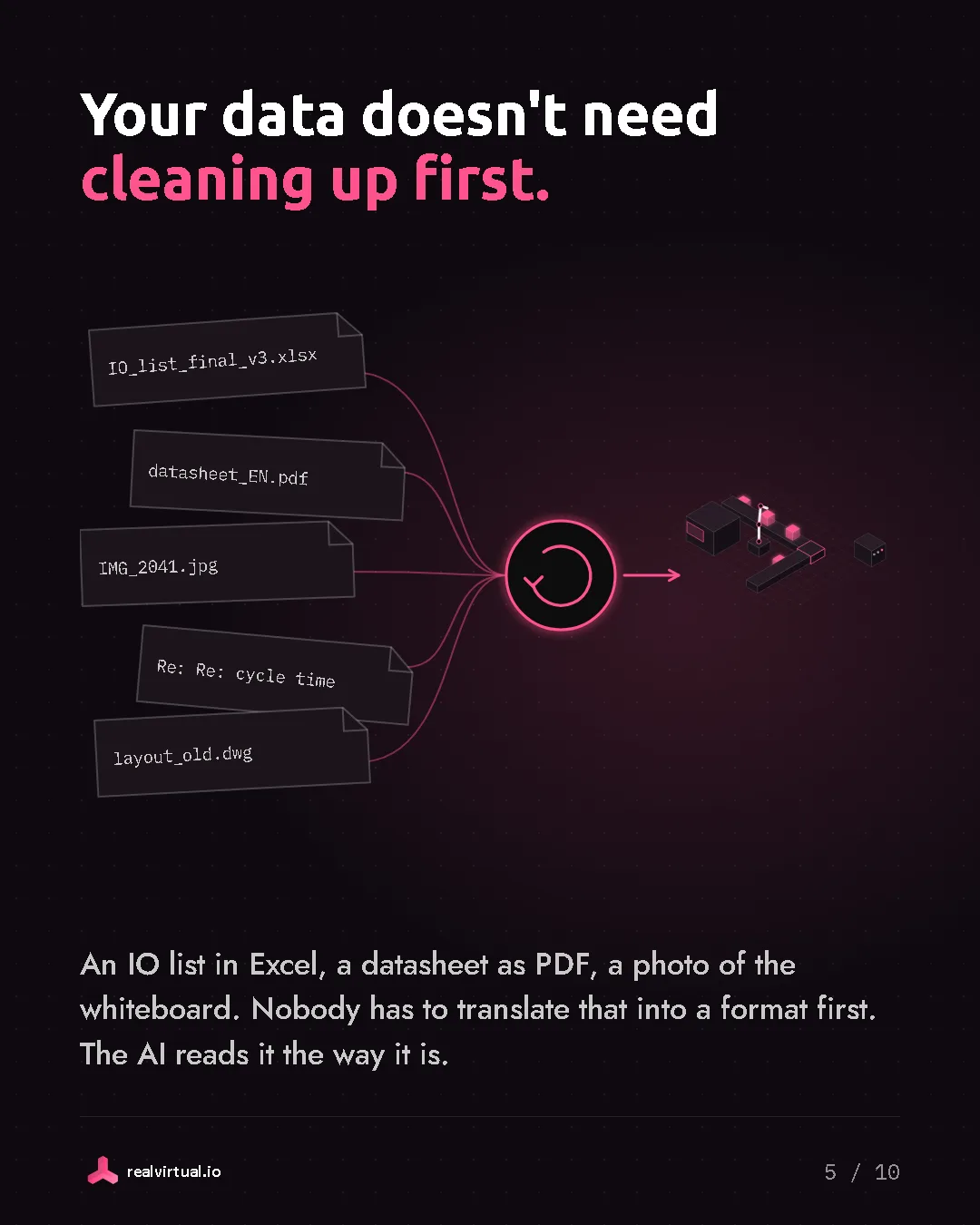
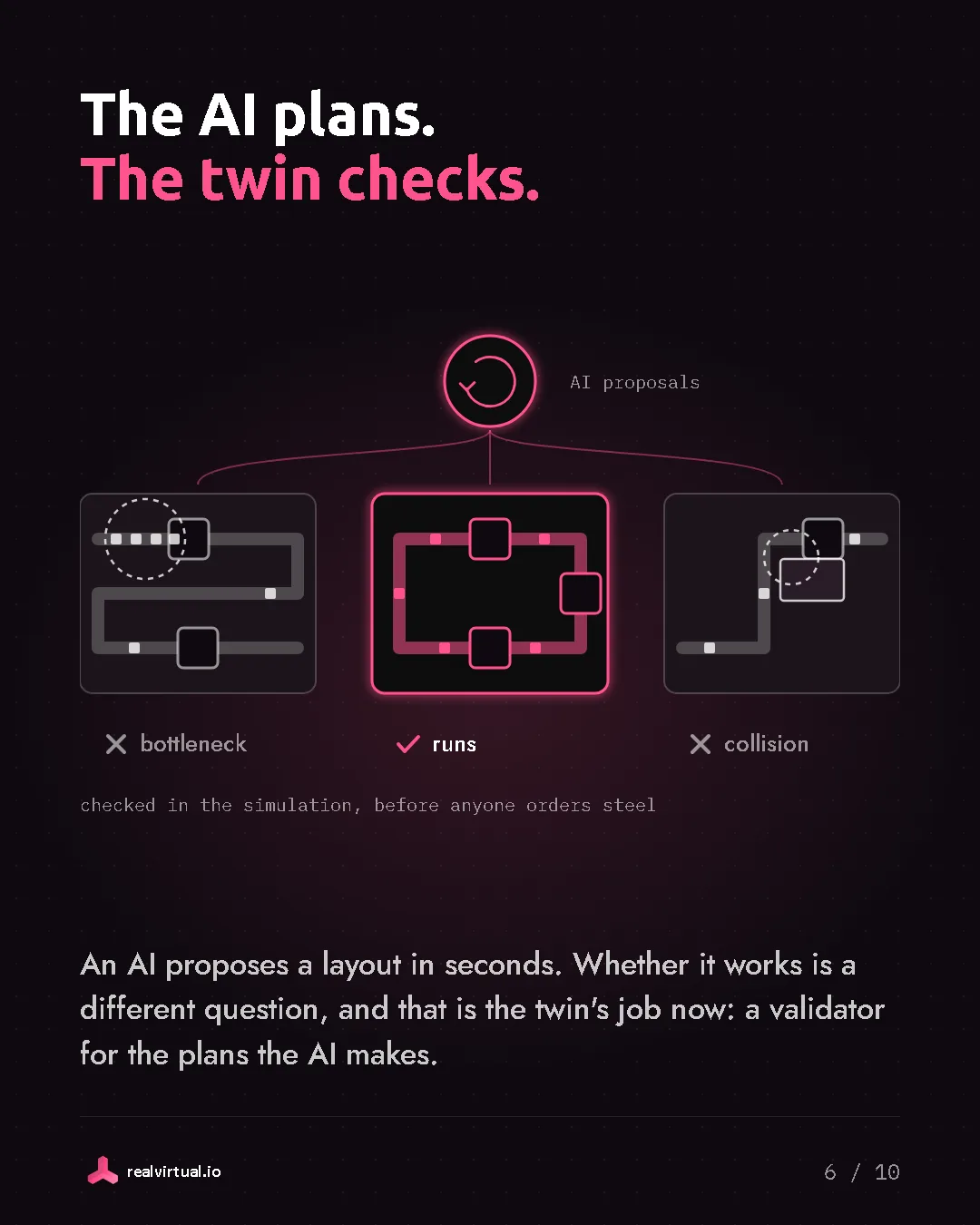
realvirtual WEB reads STEP, JT, GLB and USD, and picks up JT kinematics when the file carries them. The AI takes the tree from there and names what it finds. Axes, drives, the logic in between.

Give it more and it gets better. Documentation, drawings, EPLAN, and a CAD structure that was not thrown together. The more context a machine brings with it, the less is left to guess.

This is a preview of what is coming to realvirtual WEB. It will be free on our web demo, so you can try it with your own CAD parts.

And this is just the beginning.

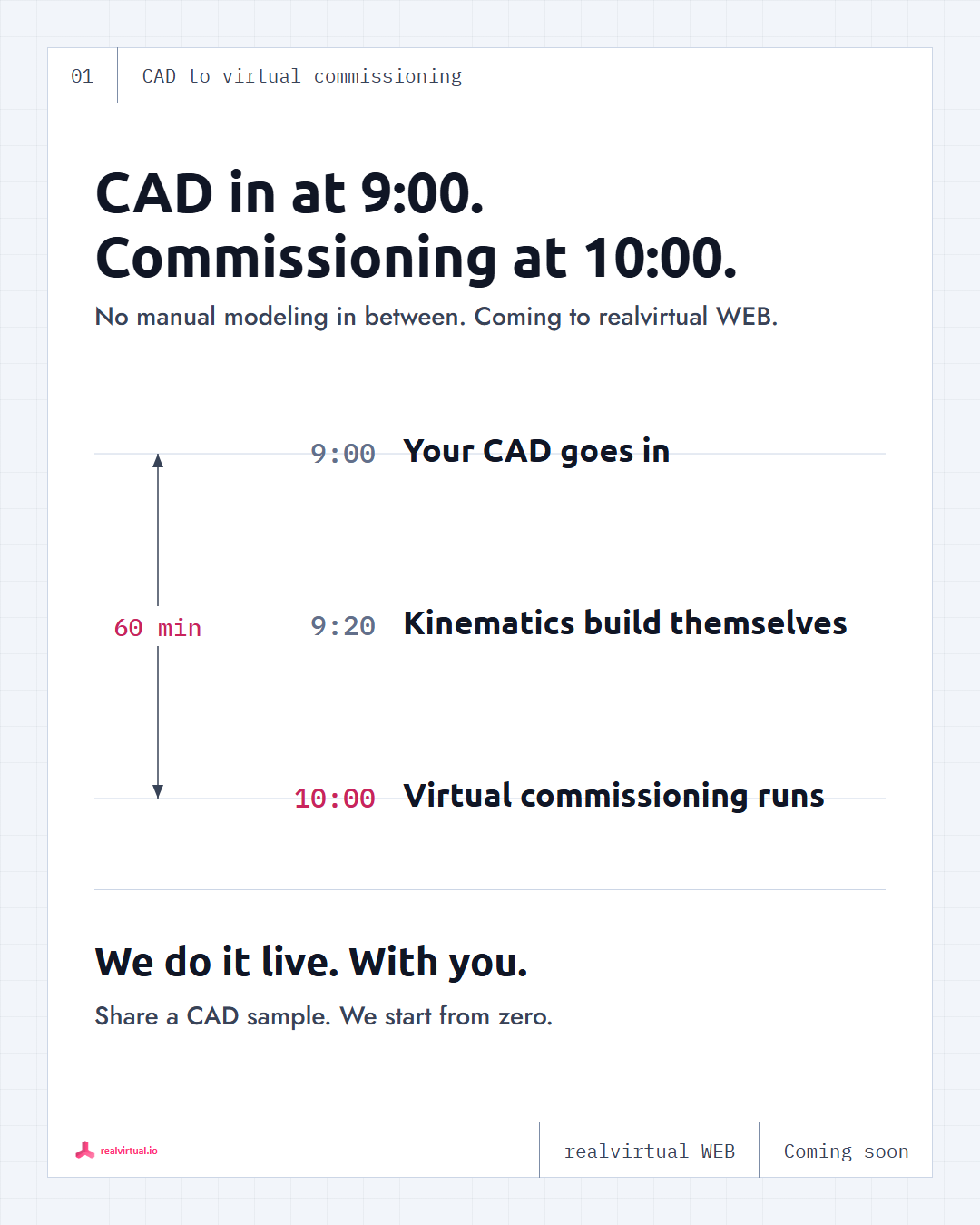
CAD in at 9:00, virtual commissioning at 10:00: a drawing sheet timeline showing CAD loaded at 9:00, kinematics built automatically by 9:20 and virtual commissioning running at 10:00, dimensioned as one hour, coming to realvirtual WEB.

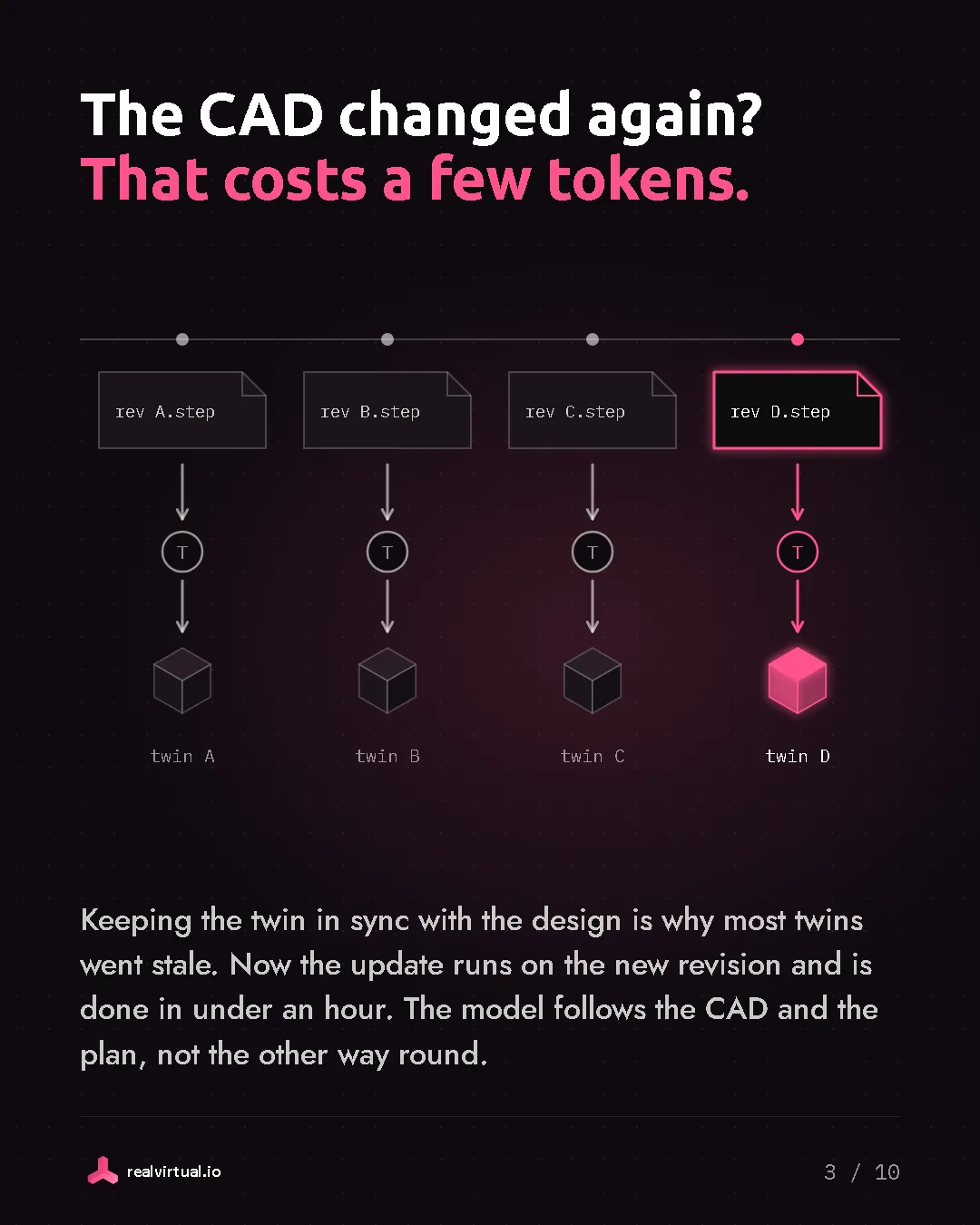
CAD in at nine. Virtual commissioning running at ten. Nobody builds the model in between.

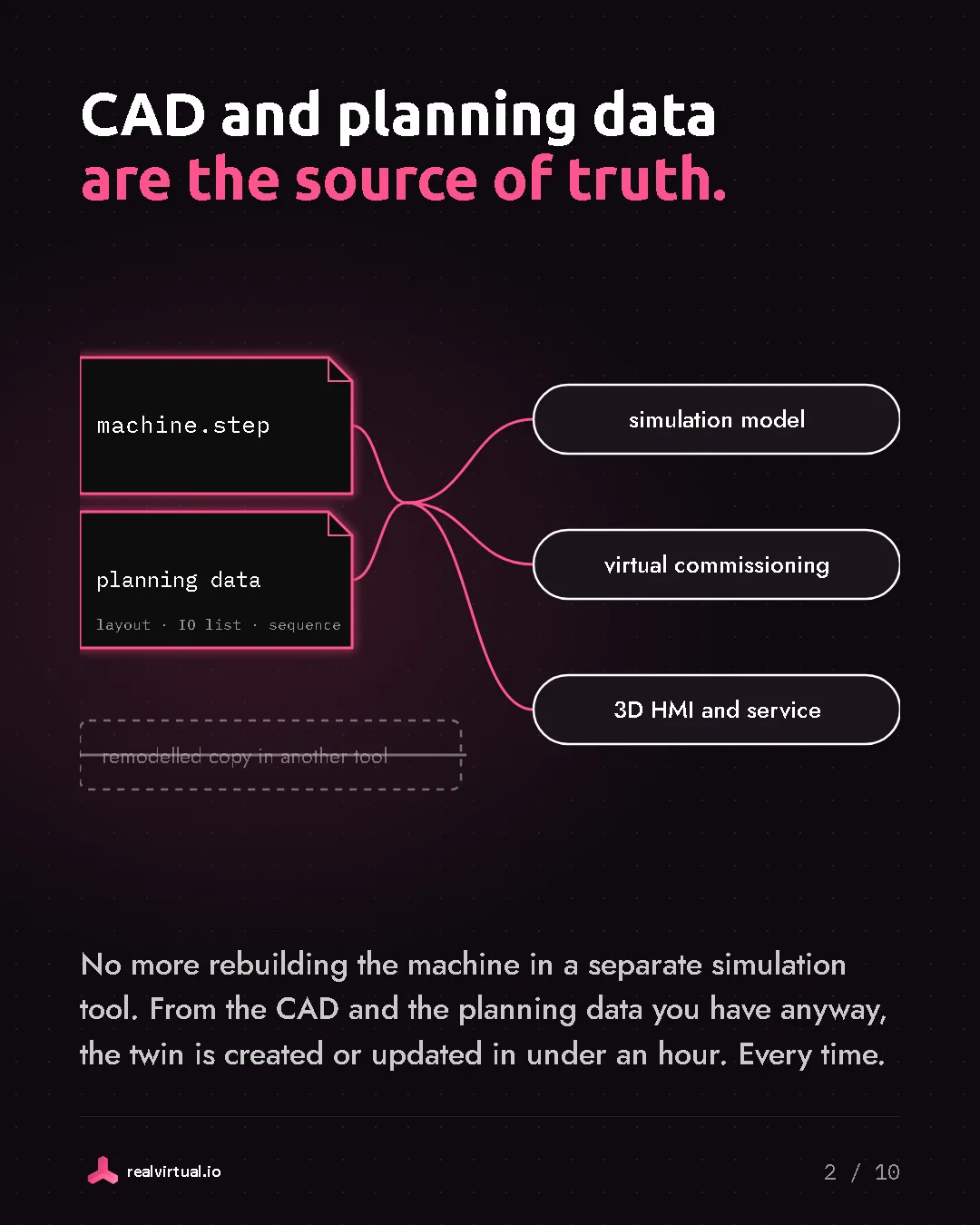
That is where realvirtual WEB is heading. You load plain CAD into a browser tab, the kinematics get found automatically, joints, axes, drives, and what comes out is a model your PLC can actually talk to. The modeling work that used to eat most of the project budget is simply not there anymore.

And it does not stop at virtual commissioning. The model lives in a browser, so the same one you tested your PLC against becomes a link. Hand it to a customer in a sales meeting so they can click through the machine instead of a rendering. Put it on your website as a demo. Take it into the real commissioning on site, on the laptop that is already there.

I know exactly how that sounds. For as long as I have been in this business, the honest answer to how long it takes before you can simulate a machine has been weeks, and every tool that claimed otherwise had a demo that only ever worked on the sample file the vendor picked.

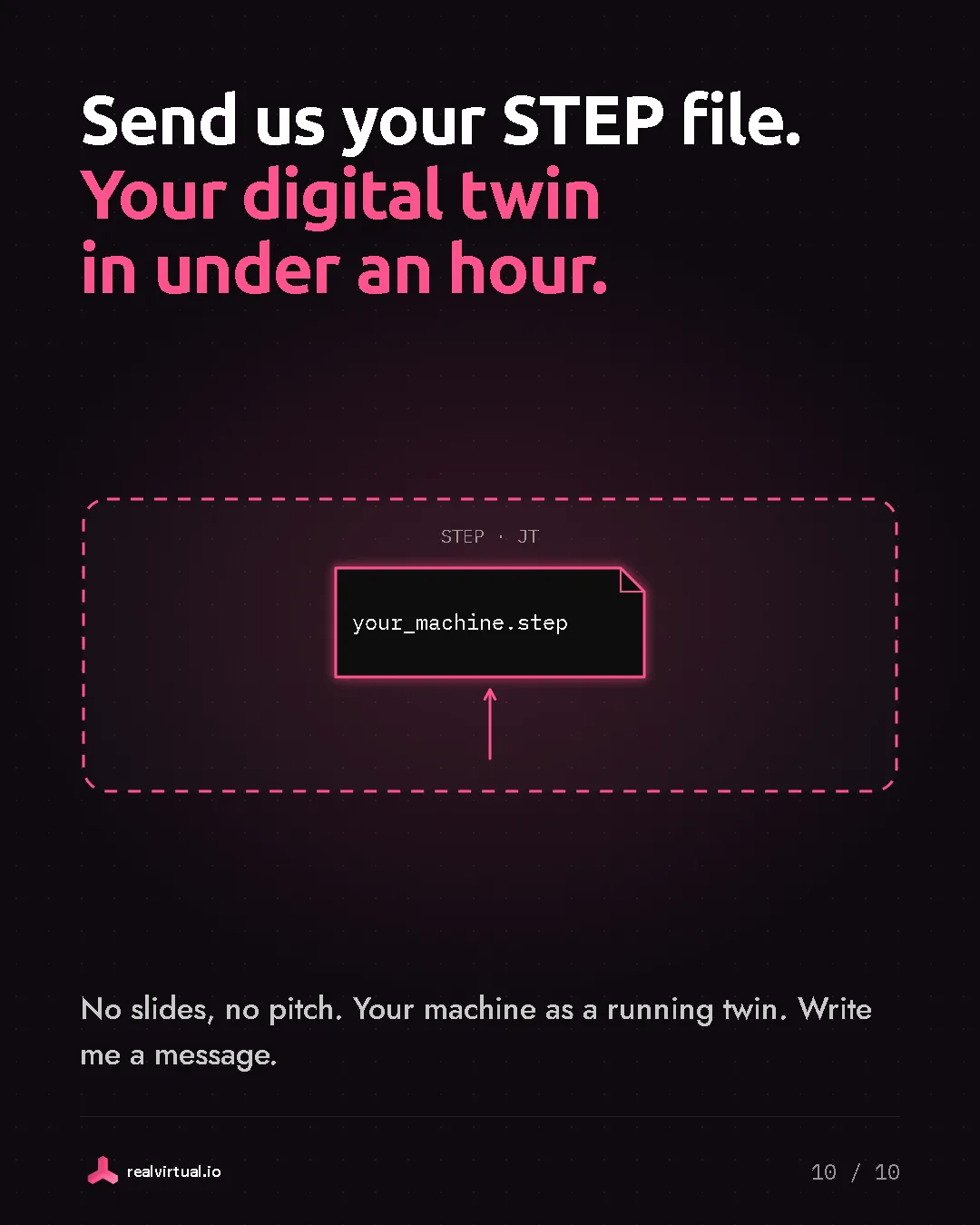
So instead of asking you to believe it, here is the offer. Share a CAD sample with us and we do it live, with you watching. We start from zero on your data, not on some clean demo assembly we picked ourselves, and you see where the hour goes. If it breaks on your file you see that too.

It is coming to the free web demo, right in your browser. Want a session with your own CAD? Get in touch.

Digital Instructions from 2027: The Regulation Allows More Than a PDF

On 20 January 2027, EU Machinery Regulation 2023/1230 becomes binding. Almost everyone reads Article 10(7) as "PDF instead of paper". The text says more. An architecture decision that has to hold for ten years hangs on it.

Most digital twins are built for virtual commissioning. Then the machine ships and the model goes into a folder.

Here is the same twin doing real work. Mauser's Cageline runs as a Machine Information System in realvirtual Web. The full 3D model, live sensor states, faults straight from the PLC, and the complete machine documentation. One browser tab.

Now with AI on top. Pick a part. Ask for the grease. The AI reads the machine documentation, names the exact grease, quotes the manual and opens the PDF on the right page. Then it lights up the part in 3D.

The answer took 90 seconds. I'll take that over an hour of digging through PDF folders.

No extra knowledge base, no training. The twin already carries the knowledge. The AI just reads it.

Virtual commissioning is where a twin starts, not where it should end. If you want this on your machine, get in touch.

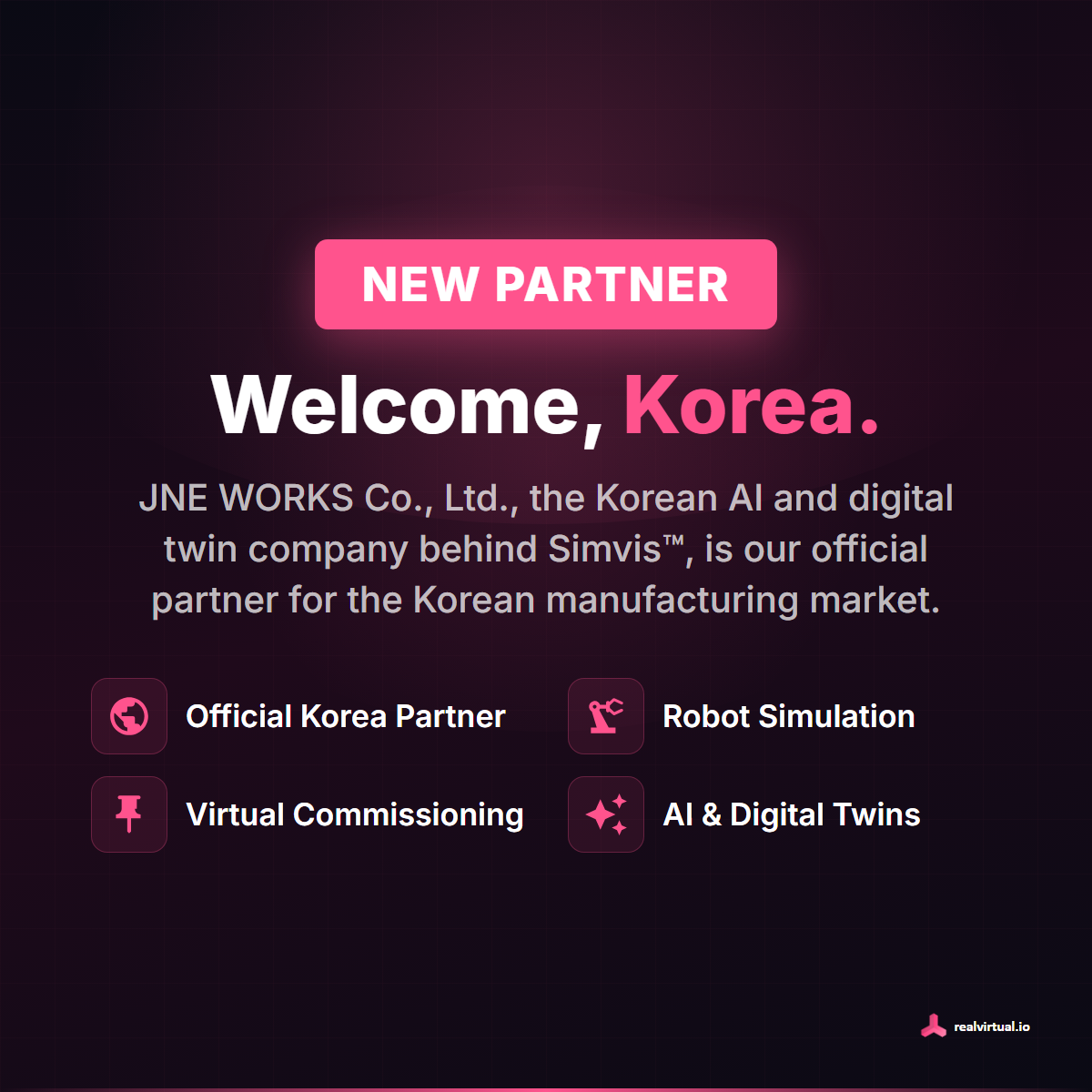
Welcome, Korea. realvirtual welcomes JNE WORKS Co., Ltd. as its official partner for robot simulation, virtual commissioning and AI digital twins in the Korean manufacturing market.

realvirtual has an official partner in Korea now: JNE WORKS.

In their own words: JNE WORKS Co., Ltd. is a Korean AI and digital twin technology company specializing in robot simulation, virtual commissioning, and intelligent manufacturing. Its core platform, Simvis™, connects CAD analysis, automated robot code generation, simulation, and digital-twin-based virtual commissioning into a single AI-driven workflow. Based on its experience in AI, robotics, simulation, and industrial digital twin technologies, JNE WORKS aims to leverage realvirtual.io to strengthen its robot simulation and virtual commissioning offerings for the Korean manufacturing market. As the official realvirtual.io partner in Korea, JNE WORKS supports customers in aerospace, defense, automotive, battery, smart factory, and industrial robotics sectors.

For machine builders in Korea that means local expertise for robot simulation and virtual commissioning, in their own language and their timezone.

Welcome on board. 환영합니다.

Their site: jneworks.com

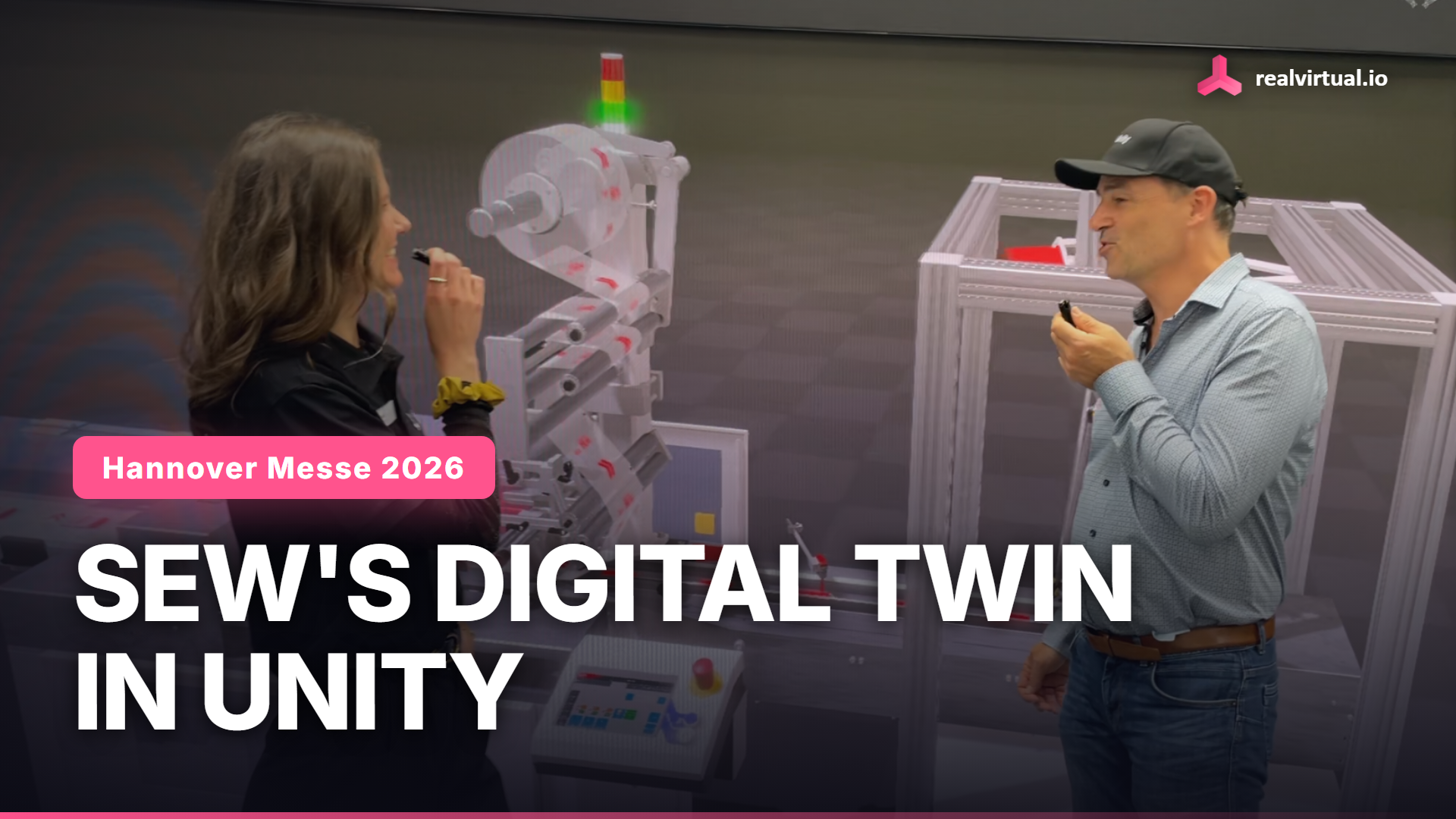
The same SEW-EURODRIVE digital twin used for virtual commissioning in Unity, later running as a live showroom demo on CMC Engineers' large-format 3D wall at Hannover Messe 2026.

Same digital twin. Two completely different jobs.

At Hannover Messe this year we showed the model we built for SEW-EURODRIVE. First job: virtual commissioning. The real SEW controller wired straight into the Unity model, testing control logic before the machine physically existed.

Second job showed up later. The exact same twin now runs as a live showroom demo on CMC Engineers' large-format 3D wall. No machine on the show floor needed, built-in explain functions so a visitor can open a door or watch a station cycle on demand.

Same stack both times. Unity as the engine, realvirtual.io Professional as the plugin for kinematics, drives, sensors and controller interfaces. Building the twin still takes real mechatronics knowledge, drag-and-drop in the Unity Editor, no code. Getting it onto CMC's wall is one Asset Bundle export.

Commissioning tool in the morning, sales floor showpiece in the afternoon.

Watch the interview, recorded live with our partner CMC Engineers.

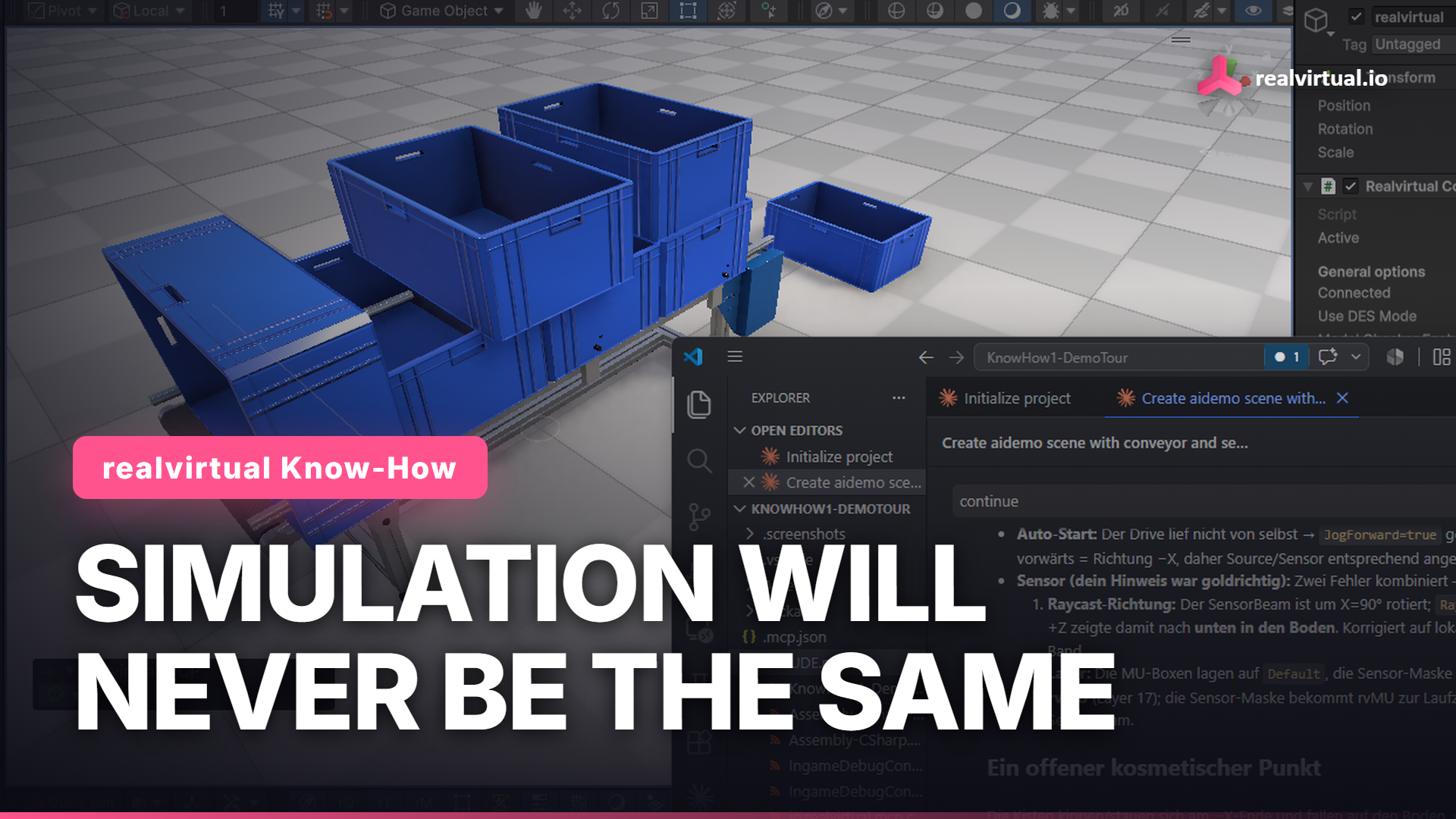
An AI agent controls a live digital twin in Unity through the free, open-source realvirtual MCP Server: a conveyor moving parts on the left, the AI agent chat on the right.

Control Your Digital Twin with an AI Agent (MCP) in Unity

The best AI agents work by calling tools, so an open system beats a closed one. Here is how the free, open-source realvirtual MCP Server lets Claude or any MCP client run a live digital twin in Unity, no code.

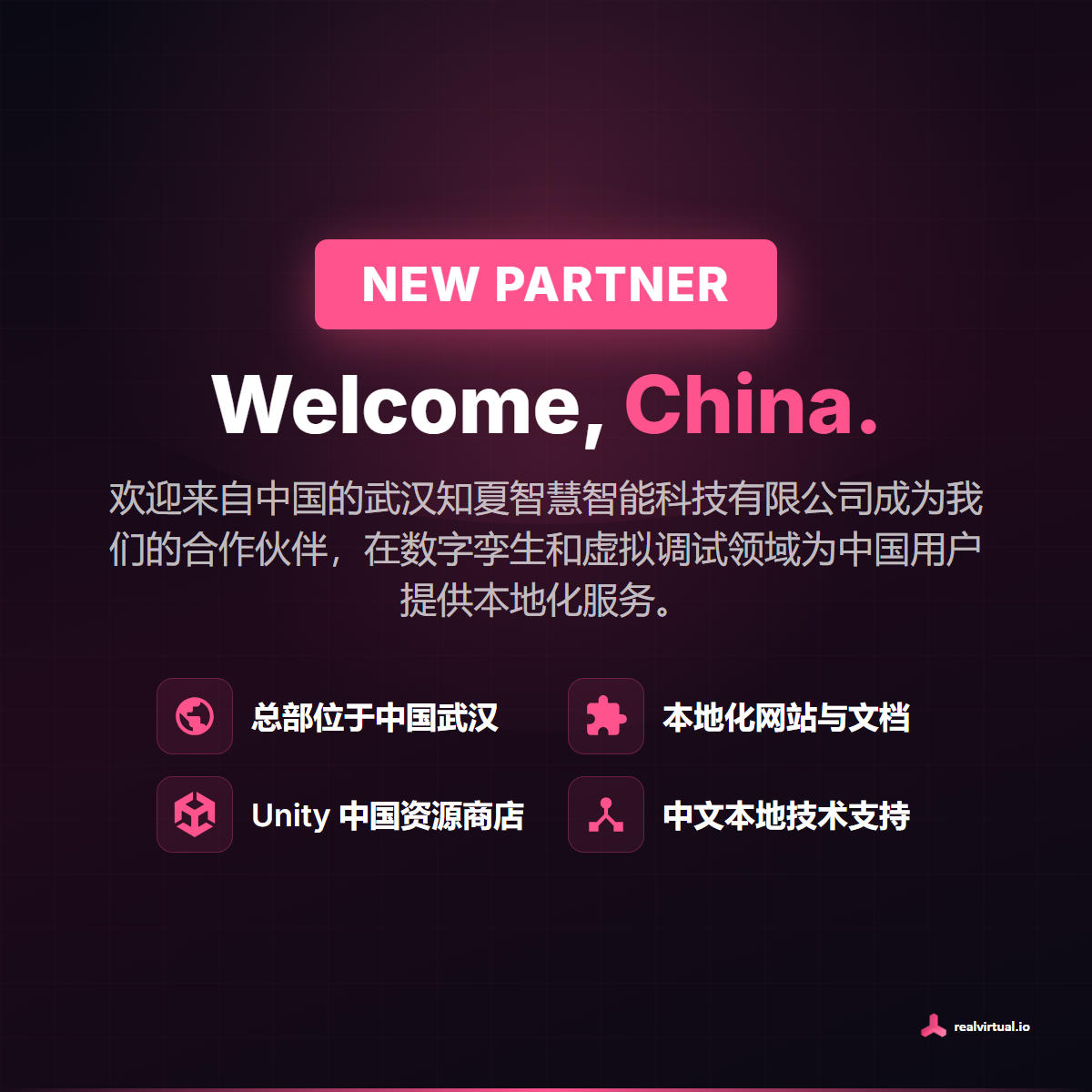
Welcome, China. realvirtual welcomes Wuhan Zhixia Wisdom Intelligence Technology as its new partner for digital twins and virtual commissioning in China, announced with a Chinese-language graphic.

realvirtual has a partner in China now, and I'm glad about this one.

Wuhan Zhixia Wisdom Intelligence Technology, based in Wuhan, is our partner for the Chinese market. They run realvirtual.io locally, with a Chinese website, Chinese documentation and support in Mandarin.

Machine builders in China working on digital twins and virtual commissioning need a partner in their own language and timezone, not a vendor twelve hours away. Now they have one.

If you build machines in China and want a digital twin you can get local help with, talk to the team at Zhixia.

Welcome on board. 欢迎.

Their site: realvirtual.com.cn

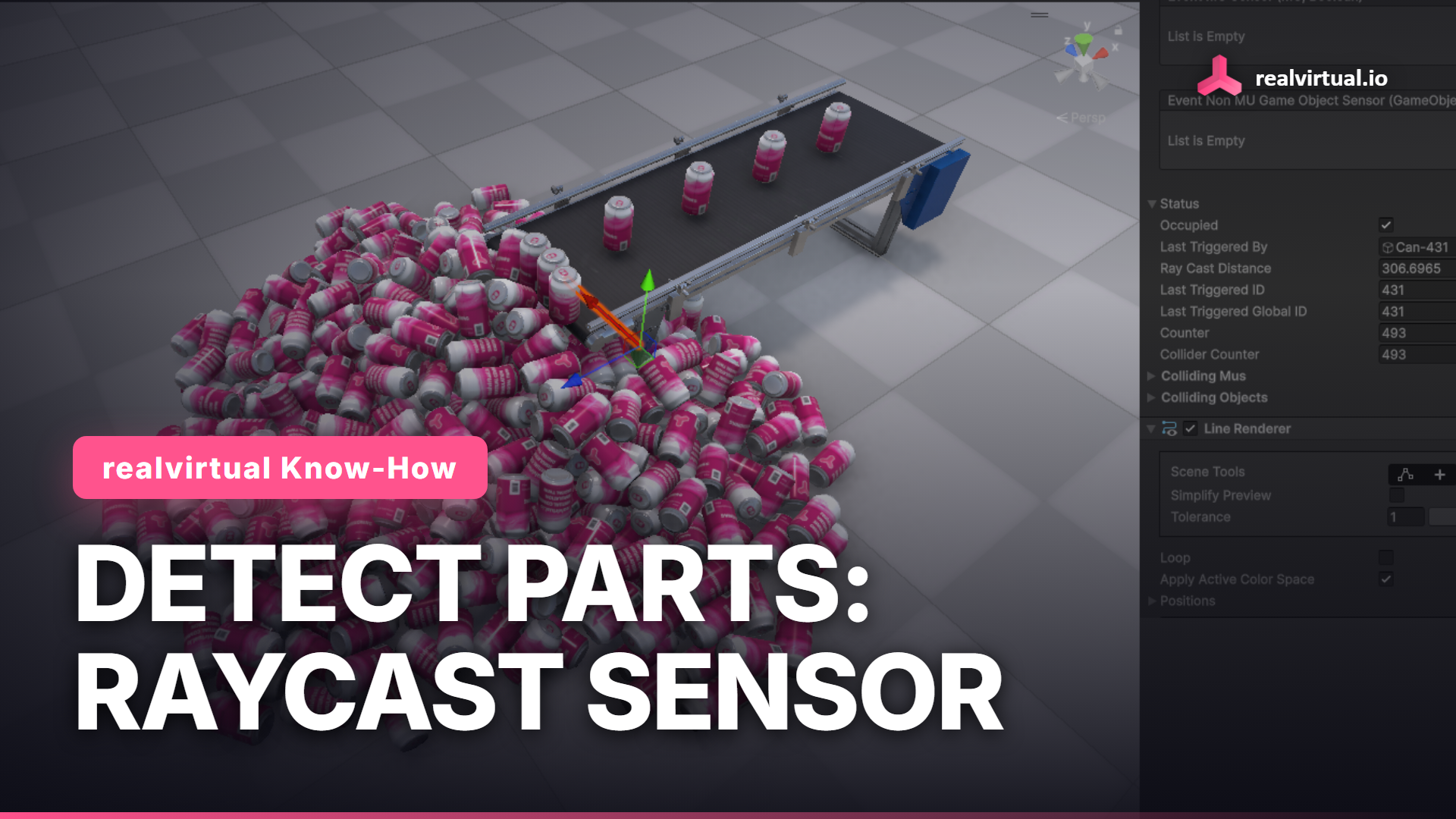
Detect parts with a raycast sensor in Unity: no collider needed, just a direction and length, with layers and a collision matrix keeping it from false triggers

Detect Parts with a Raycast Sensor in Unity

A conveyor is only useful once something downstream knows a part just went by. Here is how a raycast sensor detects parts in realvirtual.io, no collider needed, and why layers and a collision matrix keep it from firing on the wrong thing.

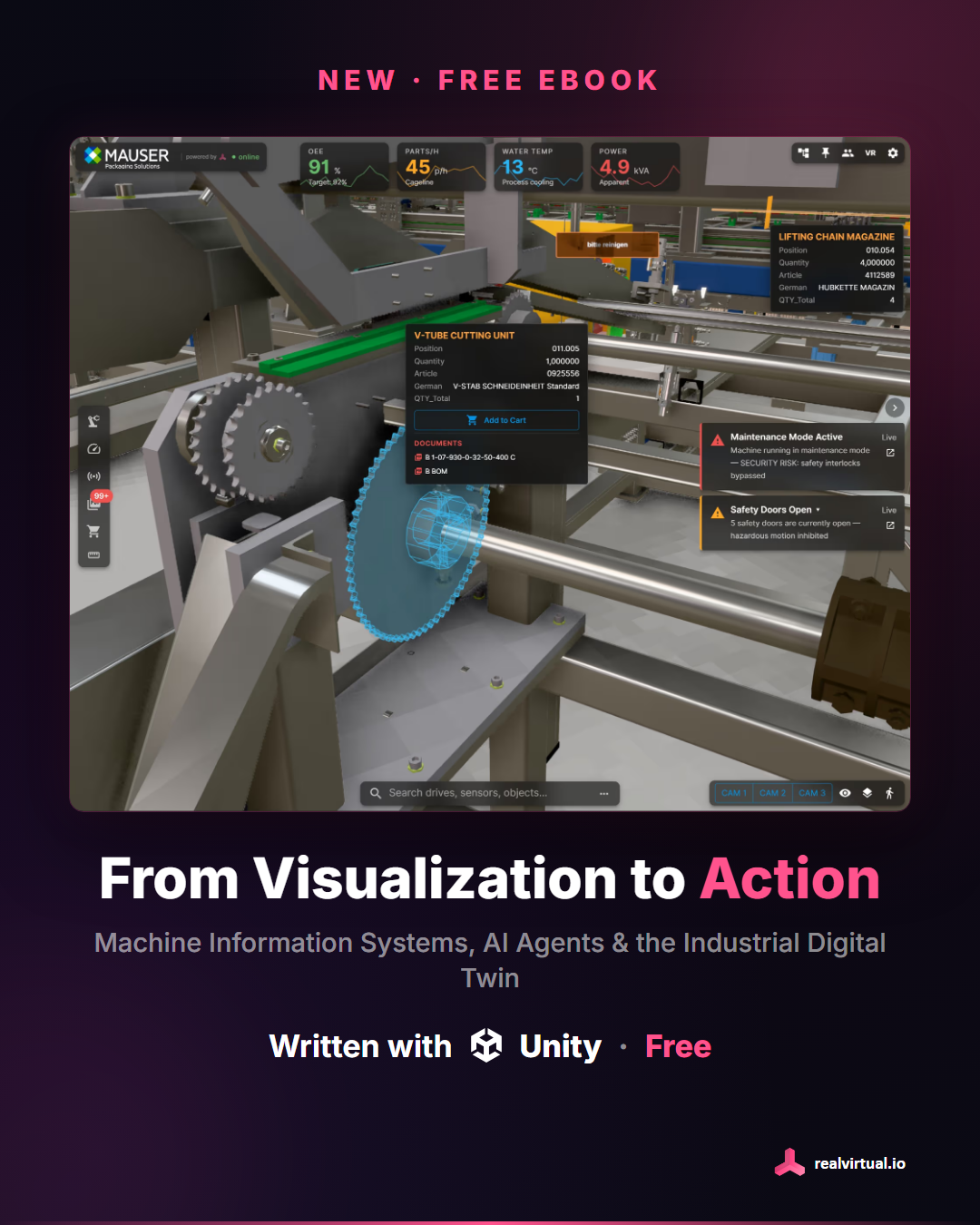
A machine information system in realvirtual Web: live KPIs, component documentation and live alerts on a Mauser packaging machine.

I wrote a book. The first one in a series, together with Unity.

It's called From Visualization to Action, and it's about a shift I keep running into on real projects. The digital twin stops being a picture of the machine and becomes the system people actually work in.

For years a twin was something you looked at. You built it for virtual commissioning, watched it run, and that was mostly it. Now the same model carries the live signals, the MES context, the documentation and the 3D HMI, all resolved on the component you click. That is a machine information system. And it happens to be exactly the foundation an AI agent needs to do anything useful on a real machine. Most teams building twins are already halfway there without calling it that.

The whole book is built around a real machine from Mauser, not a rendering. Big thanks to them for letting us show it, and to Unity for publishing this and building the series with us.

It's free, no gate. Read it here.

I keep seeing the same waste. A team builds a great digital twin for virtual commissioning, the machine ships, and the twin goes in a drawer. Did its job, forgotten.

That always bugged me. The hard part is already built. Why does it have to die in engineering?

So we deliver it instead. The same model your engineers made, running in the operator's browser as an open platform. Nothing new to buy, no second model to keep in sync.

Here is the bit I actually like. A fault hits the line. The operator clicks it, the view snaps to the broken part, and instead of digging through a 200 page PDF they just ask. They get a straight answer: what is wrong, what to check first, what the last people who hit this did, and the exact manual page, open right on the part.

Same model, same project. Now it works for the people on the floor instead of gathering dust.

So, an offer. Give us one day. We build you a running prototype on your own machine. I am pretty sure it changes how you think about delivery. If not, you have lost a day.

Curious? Try the live demo or get in touch.

Discrete event simulation will never be the same again.

The tools most factories still use for material flow simulation were built back in the 2000s. Plant Simulation, AutoMod, AnyLogic, Visual Components. Powerful, but heavy desktop software, license locked, and a single seat runs well over ten thousand euros before you model one conveyor.

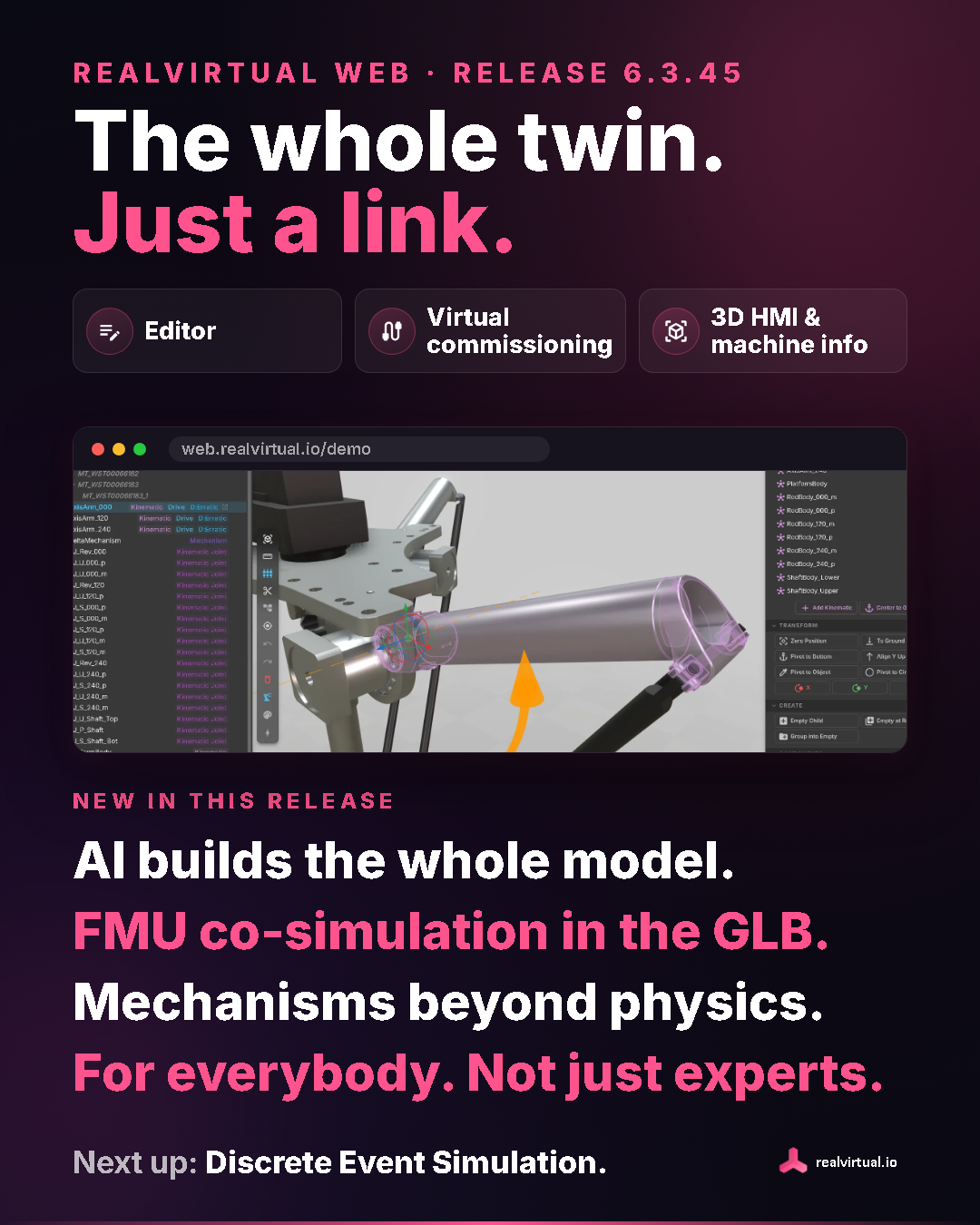
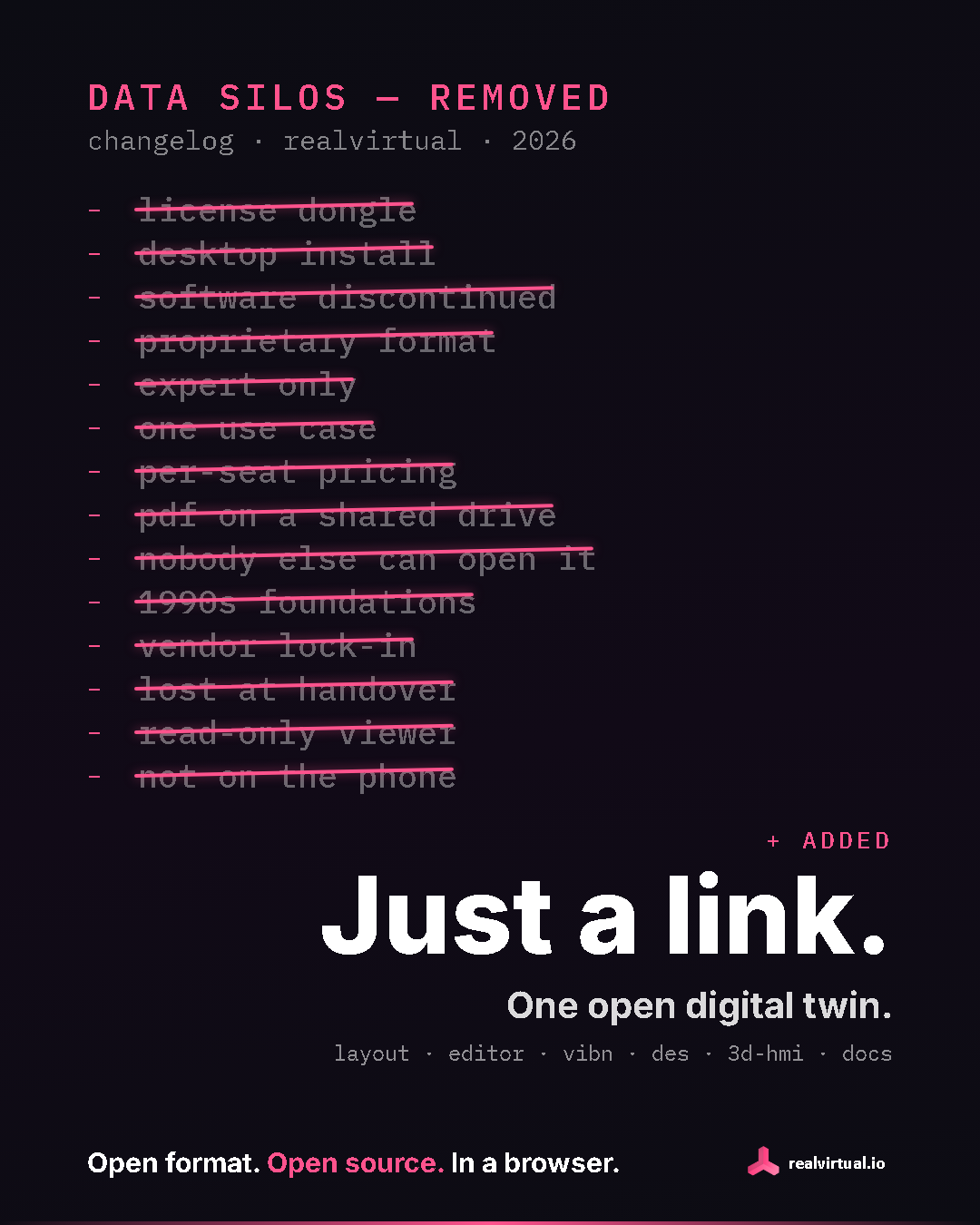
We think the future of simulation is the web. Open source, running in a browser tab, shared with a link instead of a license dongle.

What you see here is DES running live in the browser. The model is still simple, a turntable conveyor loop, but the DES core is already there: throughput per hour on every component, utilization and bottlenecks read straight off the model while it runs at ten times real time.

And it is one model, not two. The layout you planned is the model you simulate, on the same GLB, with the 3D built into the core instead of bolted on for a screenshot.

It is AI first. Build your simulation models with AI, and point Claude or Cursor straight at the running scene through the MCP bridge to build and debug them with you.

It changes the math too. A simulation study that used to eat twenty days or more now takes five or less. You keep the creative part, deciding what to model and what the line has to prove. The AI takes the painful part.

This is an early look. DES is not on GitHub yet, we are still building it and it will change. The rest of realvirtual Web is already open source on GitHub today, so you can try the viewer with your own line.

Lock-In Has No Future. AI lets competitors build faster and big organizations are too slow, so closed-source moats erode. Open plus AI over an MCP server is the durable bet.

I don't believe in the future of lock-in business models.

Siemens just showed the playbook at VivaTech, with Roland Busch on stage: heavily discounted engineering software for startups, an Industrial Copilot that writes and validates code, all under the Industrial AI revolution banner. But a discount that steep is less strategy than signal. When a startup can prompt a working tool in an afternoon, the old enterprise license is hard to justify.

The whole bet rests on the lock-in holding later, and that is getting thin from two sides. AI lets a competitor build in weeks what took years, and the incumbents are too slow to react, not because the people are weak but because big orgs decide at big-org speed. By the time the discount becomes lock-in, smaller teams have shipped around it.

There is a catch the closed vendors miss too. An AI agent is only as good as the code it can read. On open source it understands and extends the system. Behind a closed binary it is guessing. The better agents get, the more source access decides what they can do, which is exactly what a locked platform withholds.

So we bet the other way. Open instead of closed, AI on the digital twin over an open MCP server, not inside one vendor's garden. When everyone can build faster, open is the durable choice. Whoever is fast and open does not need lock-in.

You can lay out a whole production line without opening a single engineering tool.

No CAD seat. No app. No cloud. No subscription. Just a browser tab.

Drag your components onto the grid, arrange the line, done. The parts you plan with are plain GLB files, the same open 3D format the rest of realvirtual Web runs on. Nothing else to maintain.

Which means the library is yours. Every line builder and machine builder already has their components. Label a GLB once, drop it in, and it's a planner block your whole team reuses. Keep them built in, in a local folder, behind a URL, in a GitHub repo, or pull them from the Asset Store.

Here's the part I like. The labeled component you drag into the layout is the same one that later becomes the 3D HMI. You plan the line with it, the machine ships, and that exact part is now clickable in the browser, carrying its documentation and its live signal. One labeled GLB at the front of the lifecycle and at the end of it.

This is the PLAN side of realvirtual Web. Before commissioning, before the machine ships, a planner or sales engineer roughs out the layout the customer is actually buying. Same platform that later delivers and monitors it.

Online now. Free to use. Try the live demo.

Want a component to behave differently? Script it in TypeScript or JavaScript, let the AI write the code, and off you go.

Most robot paths still get taught at the pendant. You stand there and jog the robot point by point.

6.3.4 lets you do it on the twin instead. Teach the path in Unity, export it as controller code. ABB RAPID, KUKA KRL, Fanuc TP, SEW and Wandelbots. Live preview, then copy it or save the file.

Cobots work now too, and the export does blending, so the robot doesn't dead-stop at every point.

The clip is the Unity simulation, the cobot running a path I built from a handful of points in the twin. No real robot, no pendant.

Still beta. Treat the output as a starting point and check it before it goes on a real controller. If you run one of these brands, throw a path you know at it and tell me how it did.

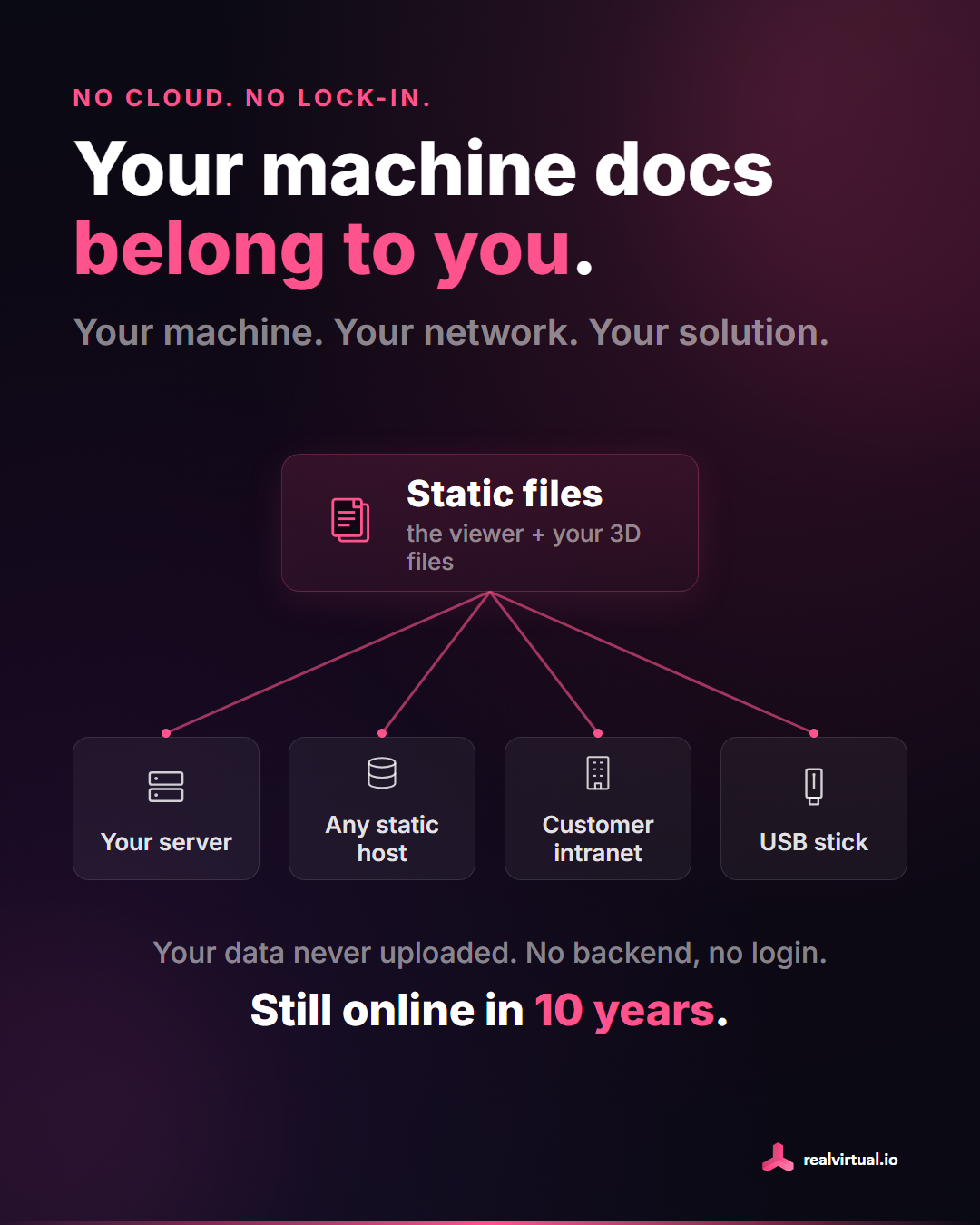
Your machine docs belong to you. Static files you host anywhere, no cloud, online for 10 years.

Your machine's documentation belongs to you. Not to a cloud you're renting.

Two things never leave your side. Your CAD is never uploaded to process it. And the delivered docs aren't a hosted service either.

What you hand over is a stack of static files. The viewer plus your 3D files, that's it. No backend. No database. No login server. No subscription.

So you can put it wherever you want:

  • your own web server
  • an S3 bucket or any static host
  • the customer's intranet
  • or a USB stick that ships with the machine

And it runs. Still runs in ten years, because a static web server is about the most stable thing on the web.

That's exactly what the EU Machinery Regulation asks for from 2027: keep the documentation online for ten years, without being chained to a cloud vendor that might go under or kill the service first.

Your delivery shouldn't depend on us still being around. So we made sure it doesn't. Hand over the files, host them anywhere, and they keep working even if realvirtual is gone.

Want to see it? Try the live demo or send me a message.

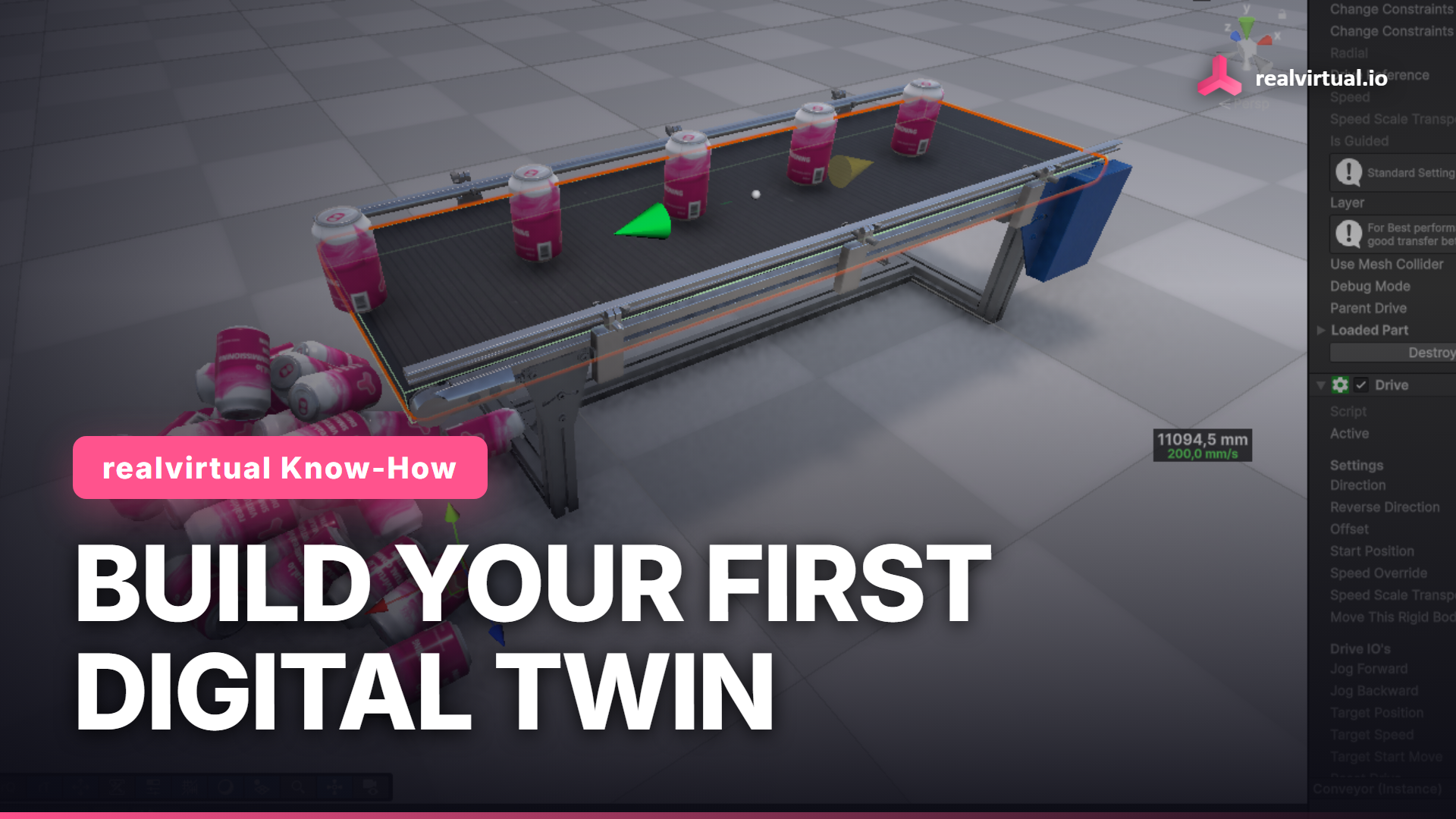
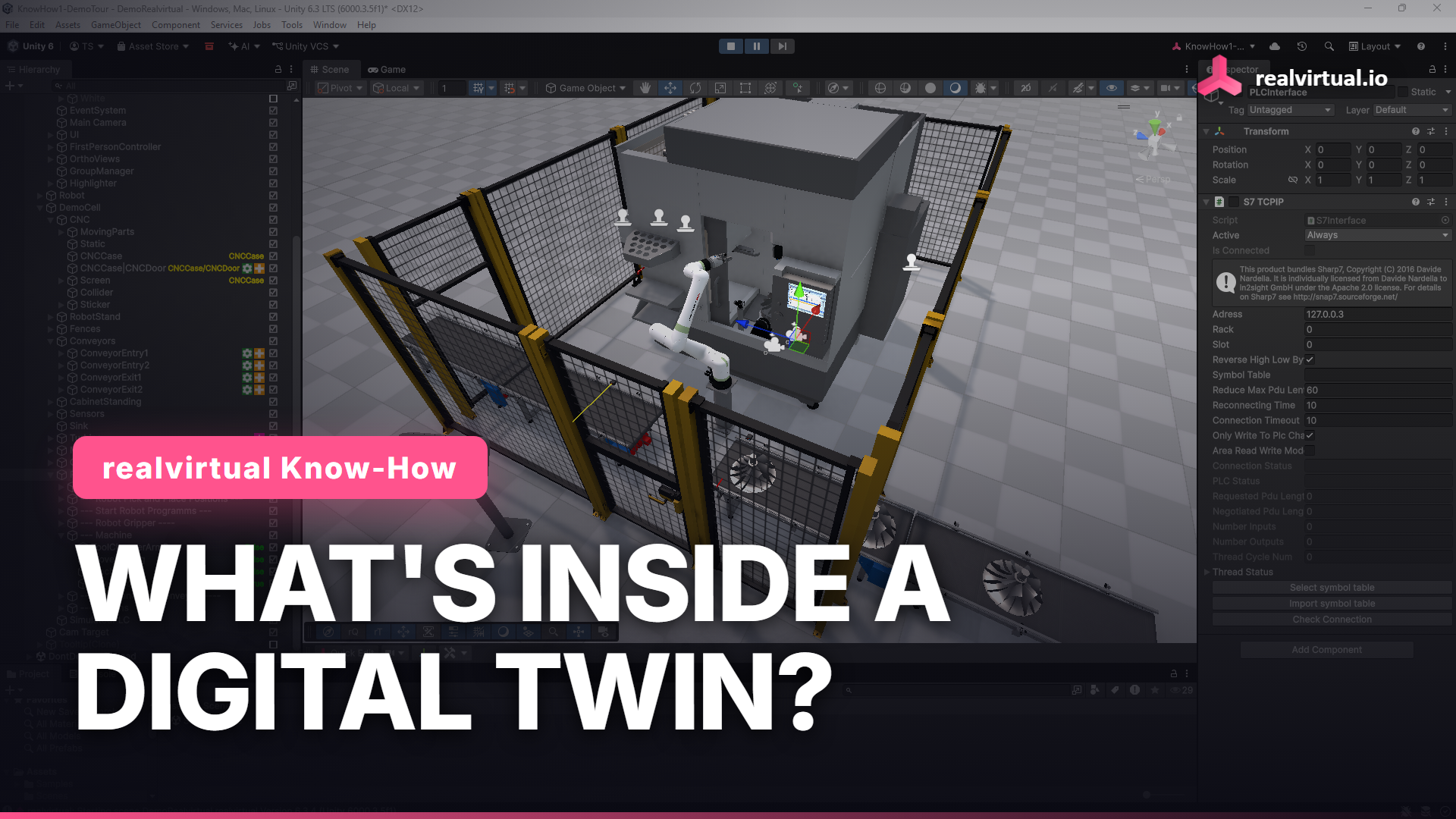
What is a digital twin in Unity? 3D geometry plus behavior: drives, behavior models, and PLC signals in realvirtual.io

What Is a Digital Twin in Unity?

People use the term digital twin for almost anything that looks like a 3D model. In realvirtual.io it means something specific: 3D geometry plus behavior. Here is what that actually consists of, explained on the Getting Started demo.

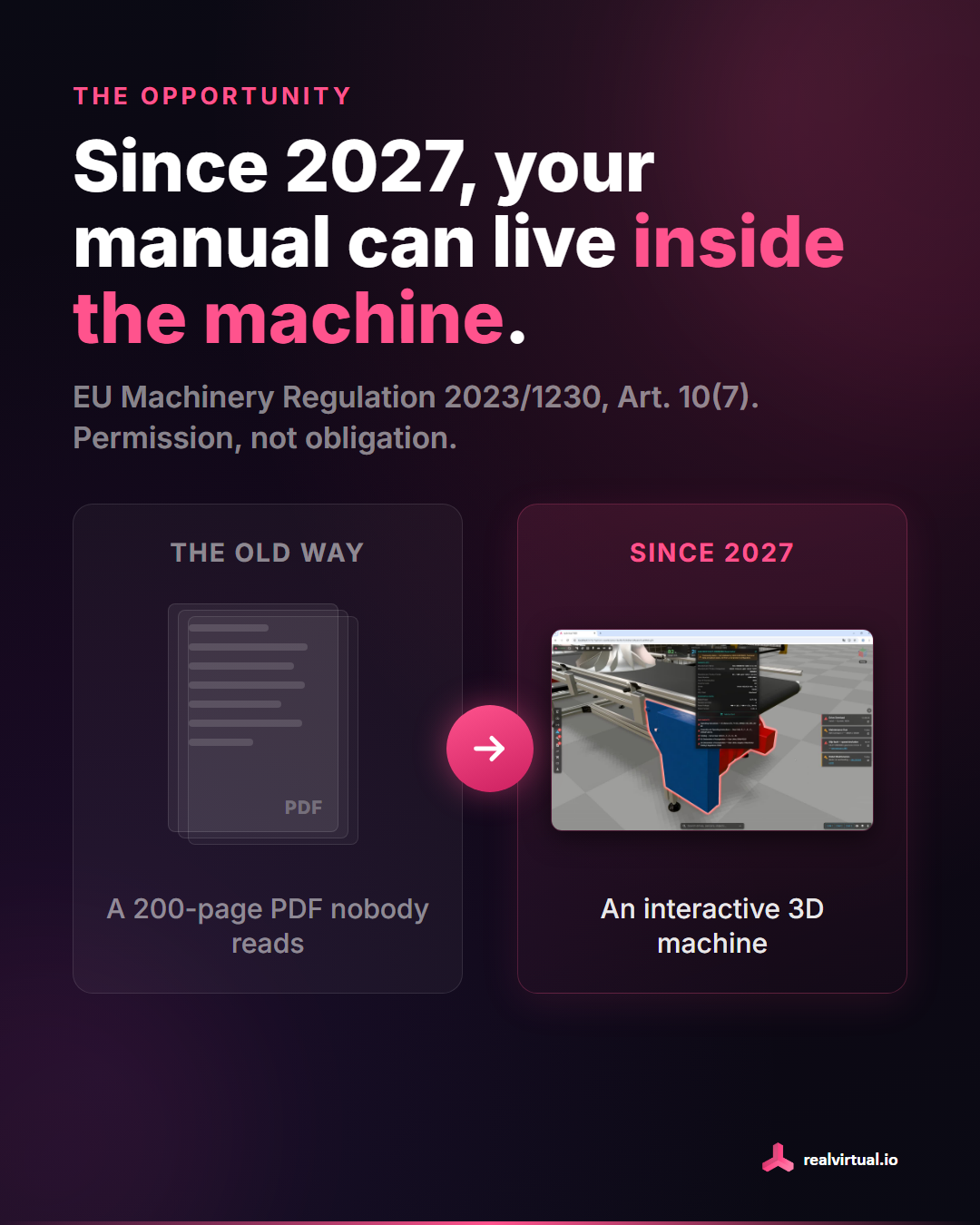
From 20 January 2027 a machine manual can be a digital, interactive 3D machine instead of a PDF. EU Machinery Regulation 2023/1230

From 20 January 2027 your machine's manual can live inside the software. Not a PDF attached to it. The 3D machine itself.

Almost nobody is doing this yet. That's the opportunity.

The EU Machinery Regulation 2023/1230 made it legal. Article 10(7) lets you hand over the instructions digitally instead of on paper. Paper is still fine, nobody forces you. You just have the option now.

The customer opens the machine in a browser, clicks the broken part, and the documentation is right there on it. No 200-page PDF. No part-number hunt.

And right now it sets you apart. Your competitor still ships a binder and a USB stick. You ship a machine people can actually use. That wins you the room in the sales meeting, not just goodwill after delivery.

One catch. Go digital and it has to stay online and downloadable for ten years. Most software won't be alive in ten years. So you can't tie your delivery to a vendor that might disappear. Us included.

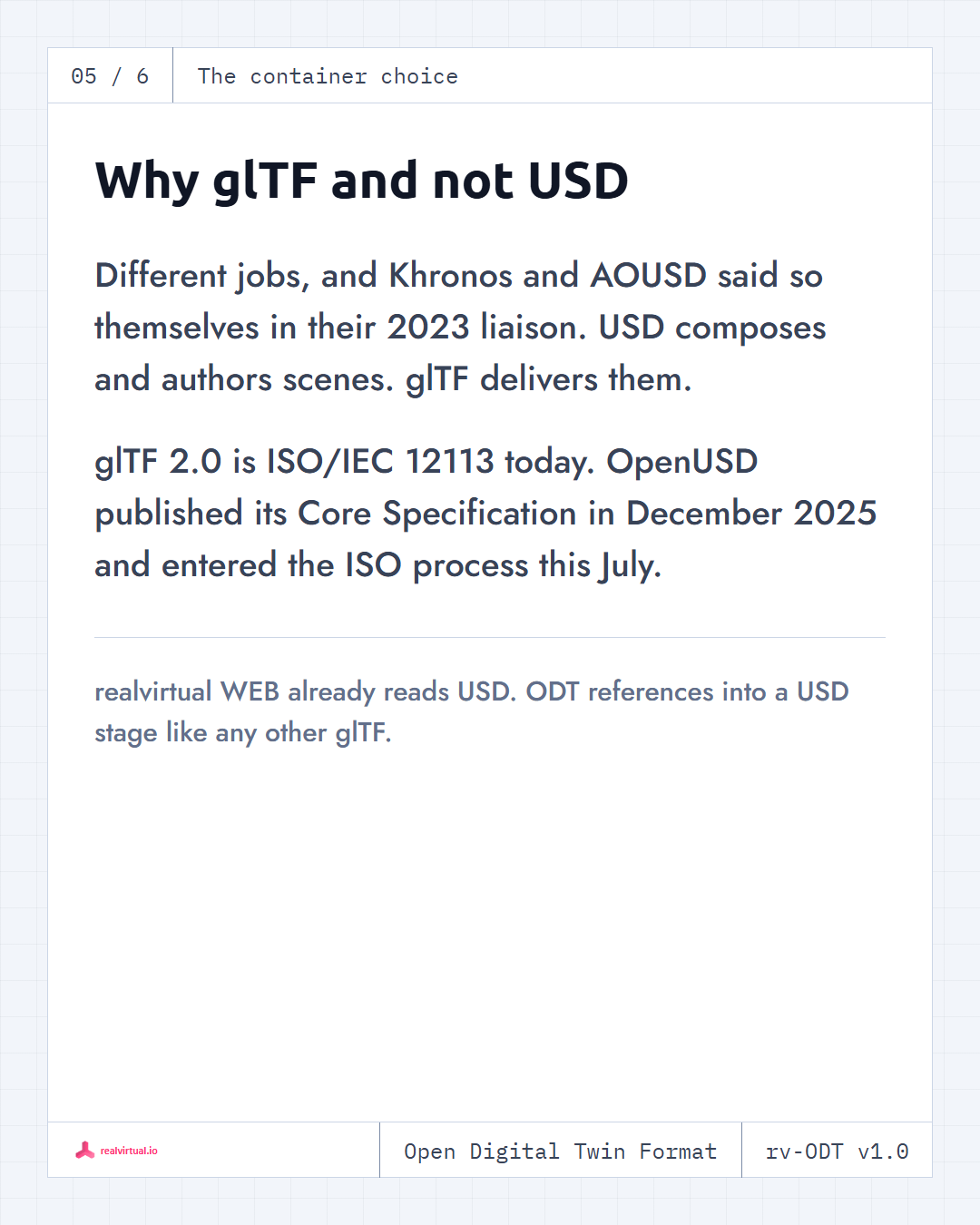
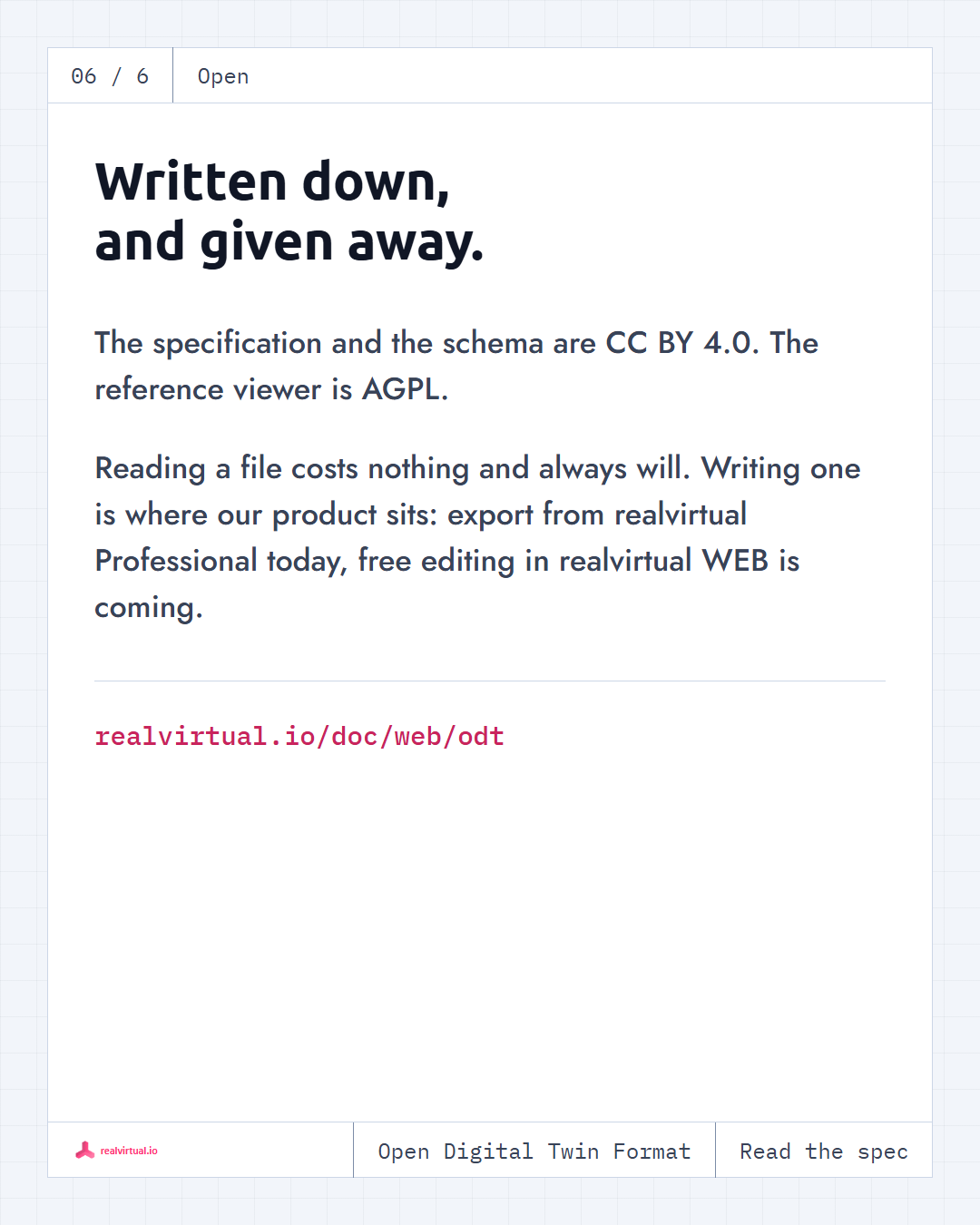
That's why we made the realvirtual Web viewer open source. You self-host it, you own it, it keeps working even if we're gone. We make our money on the authoring side. The delivery stays yours.

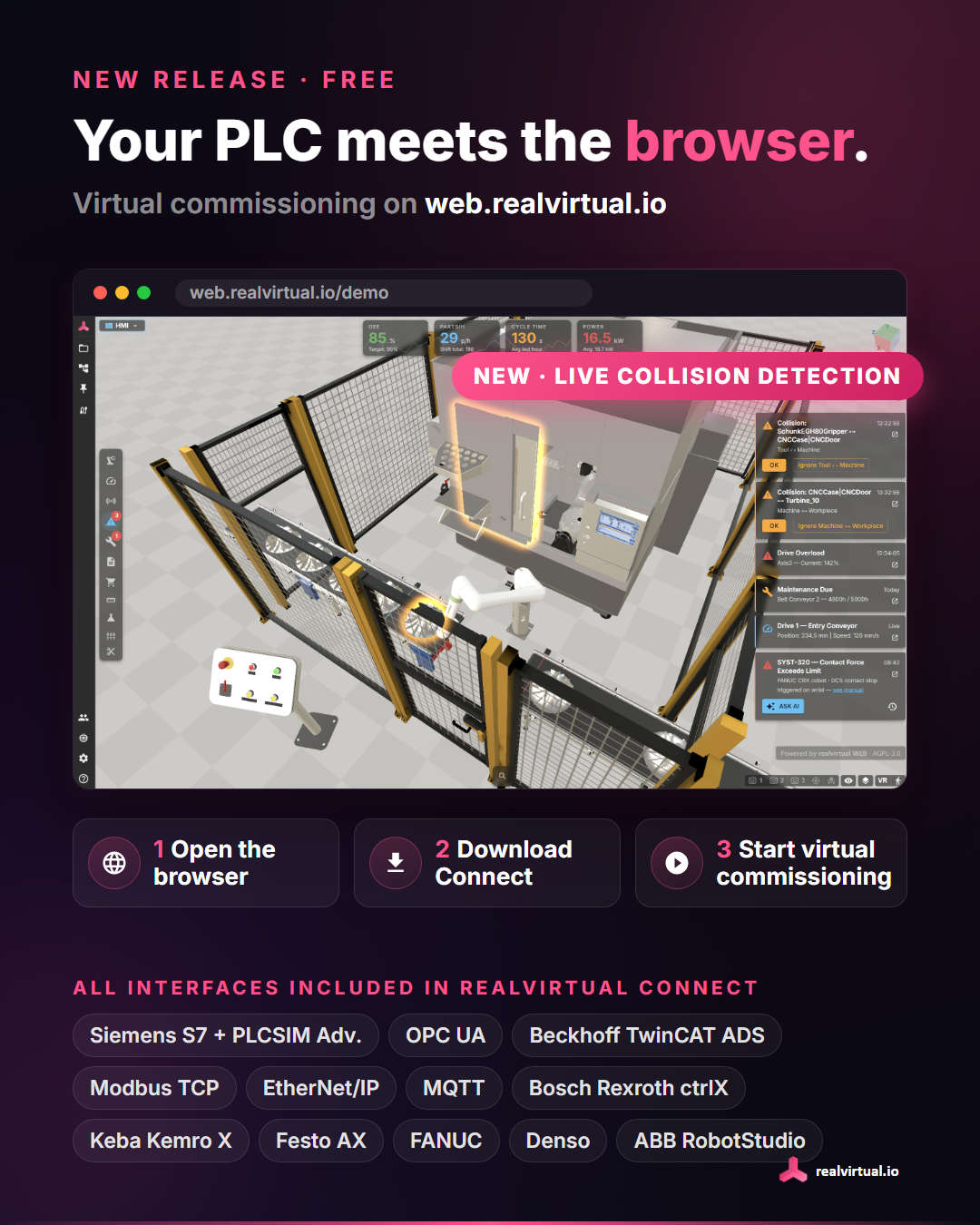
We wrote it up in full: Digital Instructions from 2027. In the meantime, try the live demo: web.realvirtual.io/demo
UnoPro Industrial Excellence — new sales and integration partner in Türkiye

We are happy to welcome UnoPro Industrial Excellence as our new sales and integration partner in Türkiye.

UnoPro Industrial Excellence is a Türkiye-based operational and organizational excellence company focused on Digital Lean Transformation, Industry 4.0/5.0, MES-IoT integration, Learning Factories, VR/AR-based training systems, and Digital Twin solutions.

UnoPro combines industrial hands-on experience, academic expertise, and implementation capability to support companies in building sustainable, human-centric, and data-driven transformation systems.

The company has actively designed and established multiple Learning Factory and Digital Transformation Center environments in Türkiye and is currently expanding its capabilities towards AI-supported Digital Twin and virtual commissioning solutions.

Welcome on board, UnoPro.

Just came back from Hannover Messe. As expected: "Physical AI" everywhere. Cloud-rendered digital twins. GPU clusters. Six-figure platform subscriptions. Complex systems built by specialists for specialists.

This is a dead end. At least for 95% of manufacturing companies.

The digital twin – as it's currently sold – is too complex, too expensive, and too locked-in to ever reach the people who actually need it: the operator on the shopfloor, the maintenance technician with a tablet, the service engineer at the customer site.

We built realvirtual WEB to change that. Because in 95% of use cases, a modern browser is all you need. Open source. One link. Any device. No cloud required. No specialists needed.

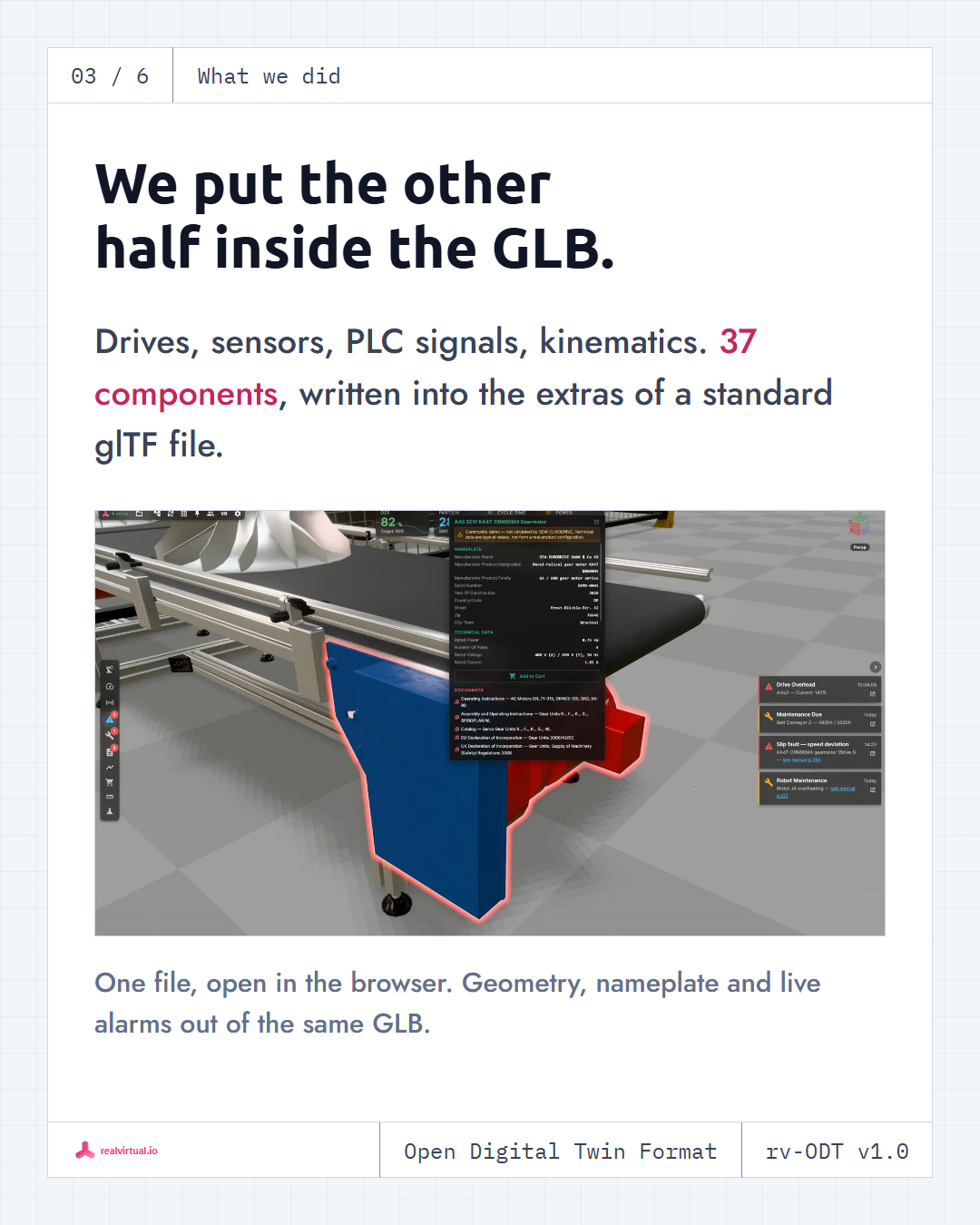
Click on a component in 3D – see documentation, spare parts, live sensor data. That's it. That's the digital twin that creates value.

And we're just getting started. Coming soon:
→ Layout planning directly in the browser
→ Discrete event simulation
→ Interfaces to external data sources like Unity Asset Manager

Keep it simple. Bringing 3D to everybody.

GitHub · 🔗 Live demo

Physical AI. World Models. Cloud-rendered digital twins. Cool demos. Zero value for the guy fixing the machine at 2am.

Your maintenance technician still looks up spare parts in a PDF catalog. Your machine documentation lives on a file server nobody can find. And your "digital twin strategy" is a slide deck your management presented at a conference.

Here's a radical idea: what if a digital twin was just... a link?

See how Mauser Packaging Solutions is transforming the way machine documentation is delivered – interactive 3D, accessible to everyone on the shopfloor. No GPU farm. No hosting. No Lock-In. No AI buzzwords. Just real value for real people. Thanks to Nils Maier for supporting what began as a vision and is now reality.

Come see the Mauser demo live at Hannover Messe – Hall 17, Booth G44.

One link. Any device. Open source.

Closed Source Is Dead — AI killed it

Closed Source Is Dead. AI Killed It.

Investing in closed source software might be the worst long-term investment a company can make today. Not because closed source is bad software – but because AI coding agents work dramatically better when they can see the full source code.

Your HMI is Still 2D? Here's What You're Missing

Last week, I watched an experienced operator spend 15 minutes clicking through seven HMI screens to locate a sensor fault. The sensor was 2 meters from where he stood. The problem wasn't the operator – it was the interface.

Accelerating AI Training with Digital Twin Technology

How realvirtual.io AI Builder is changing the game – train AI vision systems within a digital twin environment, dramatically reducing development time and improving performance.

Let's Stop Buzzwording – A Call for Real Conversations

As I walked around Hannover Messe, one thing stood out: everywhere I turned, the same buzzwords – Metaverse, Industry 4.0, Digital Twin, AI. But are these words driving innovation, or have they become catch-all phrases that obscure the real work?

More Resources

Discover our extensive learning and support materials

Documentation

Technical documentation, API reference, and tutorials

Learn More →

Community Forum

Connect with experts and other users

Visit Forum →

Video Tutorials

Step-by-step guides on YouTube

Watch Videos →

Live Demos

Try realvirtual.io directly in your browser

Start Demo →

Ready for Digital Twins?

Get started with realvirtual.io today