Hi everyone,
In simulation projects, I think one question gets asked too rarely: What do we actually need to find out?
Instead, we quickly start talking about tools, impressive visuals and computing power. I have seen this first-hand, including in the sales organisation of a large industrial automation provider. Simulation was sold and bought as if it were a single product.
Yet testing a gripper, checking a PLC program and deciding how many vehicles a warehouse needs are very different tasks.
The interest in Physical AI makes this distinction even more relevant. The tools open up exciting possibilities. Choosing the right method is what turns those possibilities into useful answers.
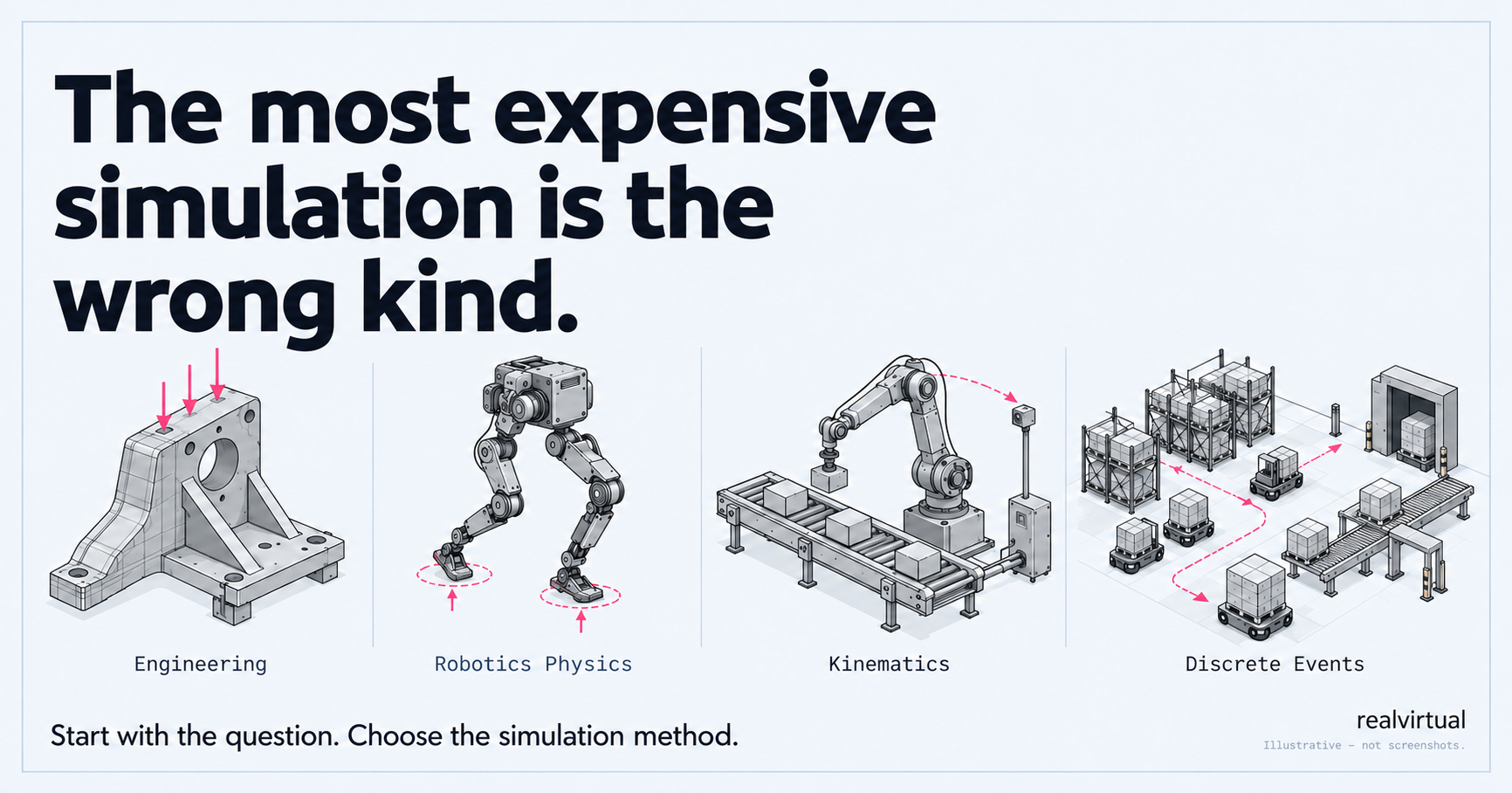
Four categories, four different jobs
I find the following four categories useful. Their boundaries overlap, but each helps us answer a different kind of question.
1. Engineering simulation: Will the part withstand the load?
For forces, stresses, deformation or detailed sensor behaviour, we need specialist methods and the right material or sensor data. We also need to validate the model for the task. That level of detail matters when the decision depends on it. It does little on its own to tell us how many vehicles a warehouse needs.
2. Real-time and robotics physics: How does the system behave under forces and contact?
Parts fall, slide and tip. Containers push against each other. A robot has to keep its balance.
Our walker with MuJoCo makes this tangible: actuators, friction and ground contact determine how it moves. Whether it walks or falls depends on its controller and model parameters.
These simulations can be highly detailed. How much we can trust their results depends on the data, the modelling assumptions and validation.
3. Kinematic simulation: Do the motion and control logic work?
To test a PLC program, I need the right movements, sensor states and signal sequences. Often, I do not need to calculate contact forces.
Drives move to positions. Parts are transported, picked up and placed. The real controller can be tested against this model before the machine is built. This is a key foundation of virtual commissioning.
4. Discrete-event simulation: Can the system meet the required throughput?
How many vehicles do we need? Where is the bottleneck? How much buffer capacity is enough? What happens when a machine fails?
Discrete-event simulation, or DES, focuses on operation over hours, days or weeks. It advances from event to event, making it possible to investigate long periods and many alternatives much faster than a detailed real-time simulation.
More detail also needs more knowledge
A physics model with guessed friction and unknown mass may look convincing while giving the wrong answer. A simpler model with reliable process times can be much more useful for a throughput decision.
Extra detail also takes modelling effort, computing time and energy. Before choosing a tool, I ask:
- Which decision should the simulation support?
- Which result needs to be accurate enough for that decision?
- What data do we actually have?
- How many alternatives do we need to compare?
- How will we validate the result?
Those answers guide the choice of method.
Putting the method to work
In realvirtual, we choose the simulation approach to suit the task, from kinematics to physics and DES. Our MuJoCo walker is one example of the detail-physics approach, currently in Beta.
Usually, one real-time approach is enough. Combining approaches by zone is useful for specific cases, such as a kinematic conveyor with a physics region at a transfer point. For capacity planning, DES uses the same layout and shared model components, with process times and capacities in place of detailed motion and control.
Specialist engineering analyses, such as stress and deformation calculations, require suitable external tools.
The walker needs forces and ground contact. The controller needs motion and signals. Capacity planning needs throughput and buffer sizes.
That is why the question should come before the tool.
What are you trying to find out with simulation?
Get in touch with a couple of sentences about your task, and I will share an initial view on which method fits.
Best regards,
Thomas Strigl